

Quick Answer
Choose embroidery when you want a classic, durable, textured logo with a professional appearance. Choose DTF printing when your artwork contains gradients, photographs, fine details, or many colors. Choose a patch when you want a raised, tactile design made from leather, woven, PVC, or embroidered materials.
The best method depends on the design, hat style, order quantity, and intended use. A simple one- or two-color logo often works well with embroidery, while a detailed illustration may be better suited to a DTF transfer. Hat.co can help you compare the options before production and provides a digital mockup for approval.
Hat Embroidery
Hat embroidery applies thread directly to the hat. The design is digitized into a stitch file, and embroidery equipment uses that file to build the logo or text one stitch at a time. The result has visible texture and a raised appearance that works especially well for company logos, team marks, uniforms, and branded merchandise.
Embroidery is often the strongest choice when durability and a traditional branded look matter. It is also effective for bold lettering, simple icons, and logos with clear shapes. Small text and very fine details may need to be simplified so the design remains readable at hat size.
Hat.co offers embroidery on structured and unstructured caps and supports a range of headwear styles. Customers can submit a logo or concept, review a digital proof, and choose from available hat and thread colors. Visit the custom hats page when the goal is a quote-ready embroidery order.
Custom Hat Printing
DTF means direct to film. The design is printed in full color onto a transfer film and then applied to the hat with heat and pressure. Unlike embroidery, DTF uses ink rather than thread, which makes it suitable for gradients, photographs, complex illustrations, and artwork with many colors.
DTF can be a practical choice for smaller runs and artwork that would be difficult to reproduce with stitches. It can also support a photo-quality appearance when the design is prepared correctly. The final result depends on the hat surface, artwork, transfer size, and application process.
For complex graphics, full-color designs, and small-batch projects, compare the options on Hat.co’s custom printed hats page. The page should explain the artwork requirements, suitable hat styles, proofing process, turnaround, and quote process.
Embroidery vs. DTF Printing on Hats
🧵 Embroidery vs. DTF Printing
Compare appearance, artwork suitability, color handling, and common applications.
| Decision Factor | Embroidery | DTF Printing |
|---|---|---|
| Appearance | Raised thread and textured finish | Smooth, full-color printed finish |
| Best artwork | Bold logos, lettering, simple shapes | Gradients, photographs, illustrations, detailed art |
| Color handling | Limited by thread colors and stitch detail | Broad color range and complex color transitions |
| Perceived style | Classic, professional, premium, uniform-ready | Modern, graphic, colorful, flexible |
| Suitable use cases | Company uniforms, teams, work crews, corporate hats | Artwork-driven merch, creator drops, event designs, small runs |
| Main limitation | Very small details and tiny text may need simplification | Application depends on surface, artwork, and heat-transfer compatibility |
Embroidery works well for textured logos, uniforms, and professional branding, while DTF printing provides greater flexibility for colorful, detailed, and artwork-heavy designs.
Custom Hat Embroidery
Embroidery is a strong choice when the hat will represent a business, crew, team, or organization over repeated use. It gives a logo a dimensional finish and pairs naturally with structured baseball caps, trucker hats, dad caps, flexfit styles, and beanies.
Use embroidery when the design is recognizable in one or several solid colors. It is especially appropriate for contractor uniforms, company hats, golf events, schools, sports teams, and corporate merchandise. If your logo includes very thin lines or small words, ask for a production review before approving the design.
Custom Printed Hats
DTF is a strong choice when color complexity matters more than a stitched appearance. It may be better for artwork with gradients, photographic elements, shading, or many small color changes. It is also useful when a smaller order needs a flexible full-color solution.
A DTF transfer can work well for promotional campaigns, creator merchandise, event artwork, restaurant branding, and designs that need a smooth graphic finish. The final recommendation should consider the hat front, fabric, design dimensions, and expected use.
Custom Patch Hats
Patches offer a separate design surface that can be sewn or applied to the hat. They can be made from leather, woven material, PVC, sublimated material, or embroidery. Patches are useful when the design should feel tactile, vintage, dimensional, or interchangeable.
A patch can also simplify a design that would be difficult to embroider directly. Compare patch materials, borders, shapes, attachment methods, and hat styles on Hat.co’s custom logo hats page.
How to choose the right method for your order
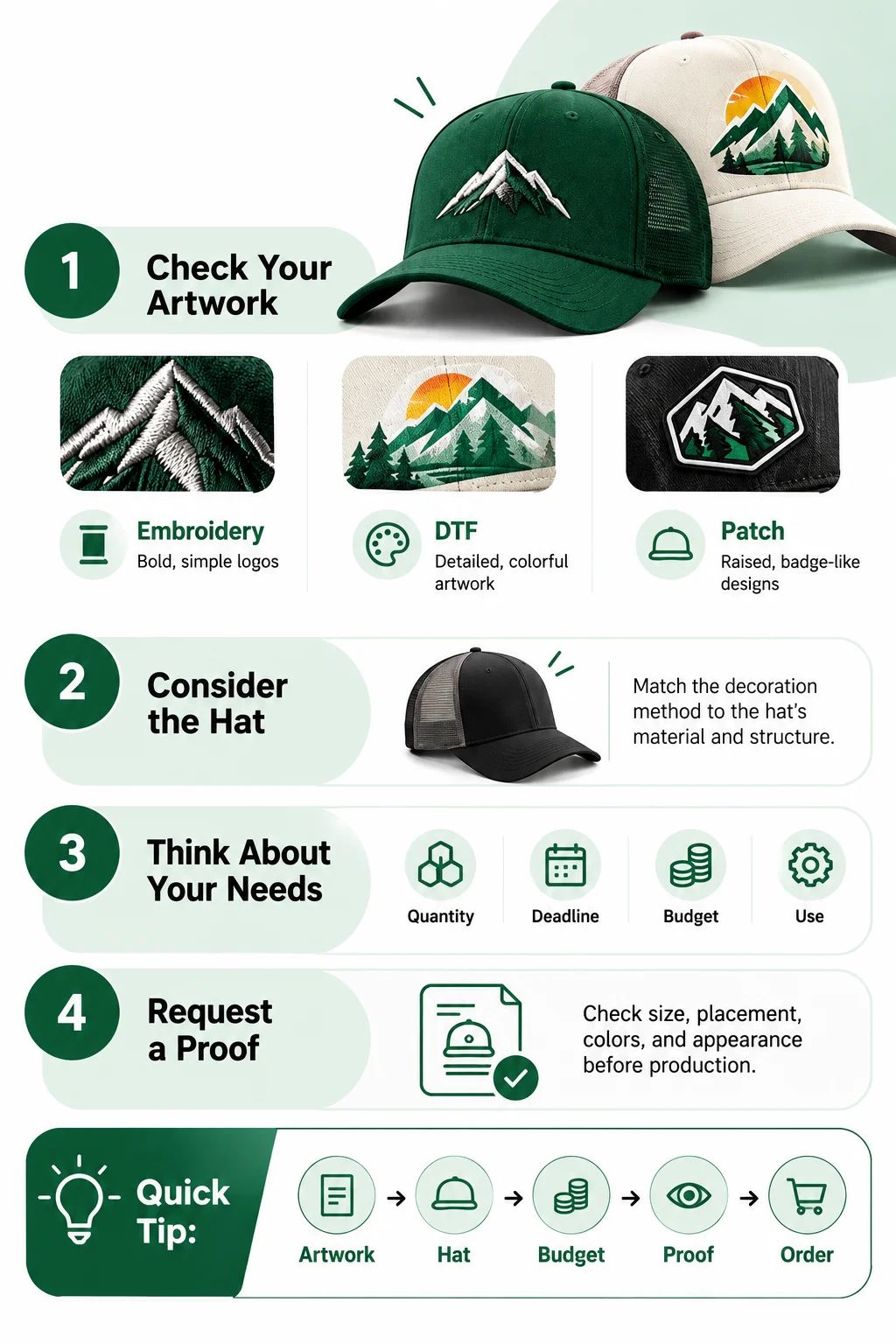
Start with the artwork. A bold logo with limited colors is usually a good embroidery candidate. A detailed illustration or photograph may be better suited to DTF. A design that should have a raised badge-like effect may work best as a patch.
Next, consider the hat. A structured front panel provides a different decoration surface from a soft, unstructured cap or a knit beanie. Then consider quantity, deadline, budget, and how the hats will be used. A work crew may prioritize durability and repeatability. A limited merch drop may prioritize color and visual detail.
Finally, request a proof. A digital mockup helps you evaluate size, placement, contrast, and overall appearance before production. It is easier to simplify a logo or change a hat style before the order is made.
Final recommendation
There is no universal winner between embroidery and DTF. Embroidery is usually the best fit for durable, professional logos. DTF is usually the best fit for complex, colorful artwork. Patches are usually the best fit for a tactile, distinctive badge effect.
If you are unsure, send Hat.co your artwork, preferred style, quantity, and deadline. The team can recommend the most suitable decoration method and provide a proof before production.