


When choosing custom embroidery for hats, the embroidery style can change the entire look of the finished design. Flat vs. 3D embroidery hats is a common comparison because both techniques create durable, professional-looking results, but they have noticeably different appearances and design requirements.
Flat embroidery creates a smooth design that sits level with the hat’s surface, while 3D or puff embroidery uses foam beneath the stitches to create a raised effect. Understanding the differences can help you choose the right technique based on your logo, hat style, budget, and desired appearance.
Flat vs. 3D Embroidery Hats: How Each Style Works
Before comparing the two methods, it helps to understand how each embroidery technique is created and what type of design it is intended to support.
What Is Flat Embroidery for Hats?
Flat embroidery is the traditional embroidery method used on many custom hats. The thread is stitched directly onto the hat material, creating a smooth design that remains relatively level with the surface.
One of the biggest advantages of flat embroidery for hats is its ability to reproduce detailed artwork. Fine lines, smaller lettering, multiple design elements, and intricate logos can generally be handled more effectively than with raised embroidery.
Flat embroidery is commonly used for:
- Company and brand logos
- Corporate uniforms
- Team hats
- Promotional headwear
- Detailed artwork
- Small lettering
- Multi-color designs
The finished appearance is typically clean, classic, and professional, making it suitable for businesses and organizations that want branding without a highly dimensional effect.
What Is 3D Embroidery for Hats?
3D embroidery, also known as puff embroidery, adds dimension to a design by placing a foam layer underneath the stitching. The embroidery stitches cover the foam and create a raised appearance.
This technique is particularly effective when the goal is to make lettering, initials, or a simple logo stand out. 3D embroidery for hats is frequently associated with sports caps, streetwear, lifestyle brands, and other designs where visual impact is important.
It generally works best with:
- Bold lettering
- Simple logos
- Large initials
- Sports-inspired designs
- Thick shapes
- Minimal graphic elements
Because the design needs enough space for the foam and stitching, very fine details and tiny text can be more challenging.
Why Is 3D Embroidery Also Called Puff Embroidery?
The terms “3D embroidery” and “puff embroidery” are commonly used to describe the same basic raised embroidery technique. The word “puff” refers to the dimensional effect created by the foam beneath the stitches.
So, when you see terms such as 3D puff embroidery hats, they generally refer to hats featuring raised, dimensional embroidery.
Flat Embroidery vs. 3D Embroidery: Side-by-Side Comparison
The key difference between flat and raised embroidery is the profile of the finished design. However, appearance is only one factor. Design complexity, hat construction, placement, cost, and intended use can also affect the decision.
🧢 Flat vs. 3D / Puff Embroidery
Compare embroidery styles by appearance, detail, cost, hat compatibility, and common uses.
| Feature | Flat Embroidery | 3D / Puff Embroidery |
|---|---|---|
| Appearance | Smooth and level | Raised and dimensional |
| Design detail | Well suited to fine details | Best for bold, simple designs |
| Small text | Generally more suitable | Can be difficult at small sizes |
| Large lettering | Works well | Creates strong visual impact |
| Hat compatibility | Works across many hat styles | Usually best on structured front panels |
| Texture | Relatively smooth | Raised and textured |
| Cost | Often more economical | May cost more because of foam and production requirements |
| Common uses | Business, uniforms, detailed logos | Sports, streetwear, bold branding |
| Maintenance | Straightforward | Requires care to help preserve the raised effect |
Flat embroidery is a practical option for detailed logos and smaller text, while 3D puff embroidery adds noticeable height and texture to bold designs. Consider the hat structure and artwork size before choosing.
Neither method is automatically right for every project. The artwork and hat should be considered together before choosing an embroidery technique.
3D Embroidery vs. Flat Embroidery: Which Designs Work Best?
The artwork itself is one of the most important factors in deciding between these two embroidery methods.
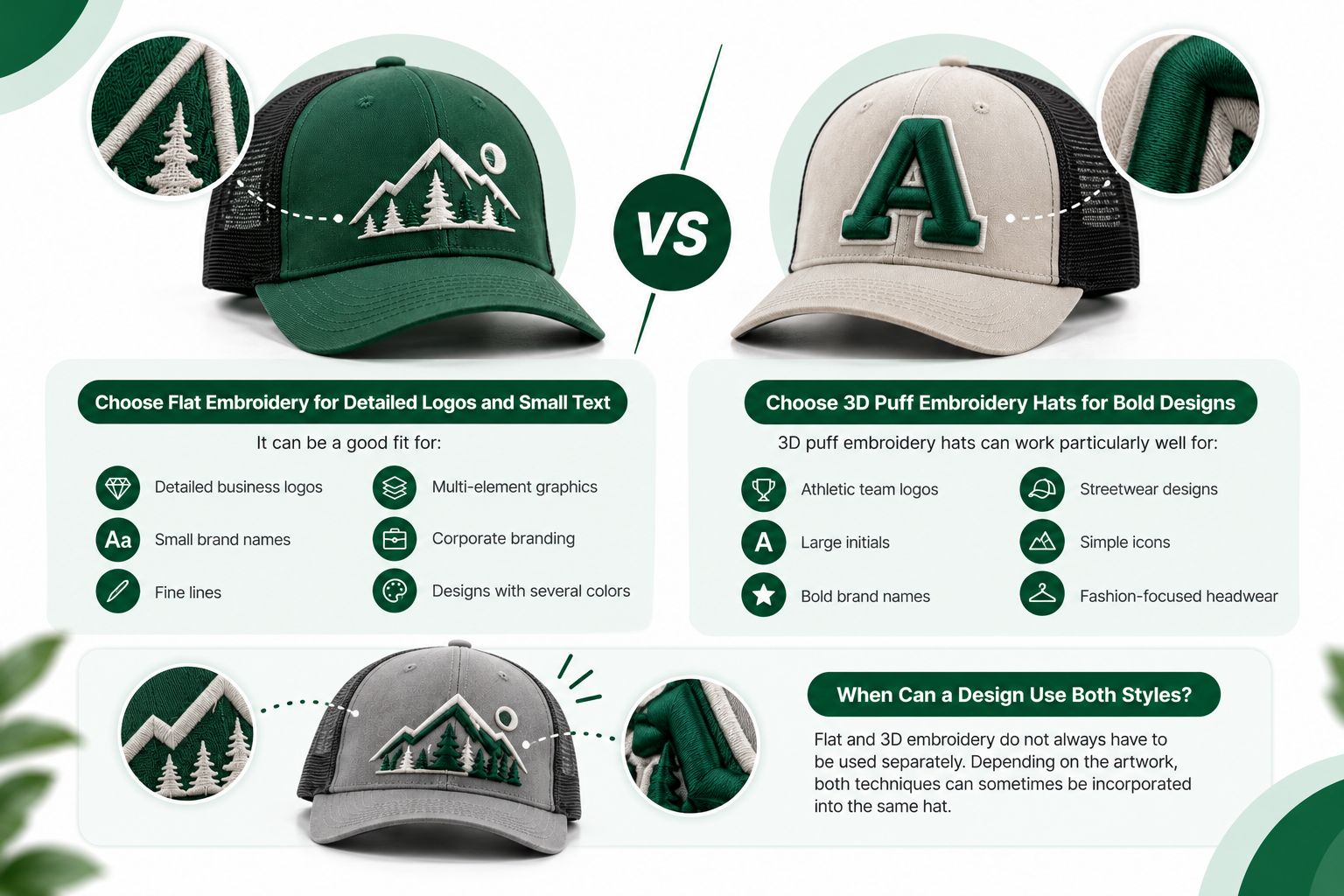
Choose Flat Embroidery for Detailed Logos and Small Text
Flat embroidery is often the more practical option when your design contains intricate details. Because the thread is stitched directly onto the material without foam underneath, the embroidery can accommodate finer elements.
It can be a good fit for:
- Detailed business logos
- Small brand names
- Fine lines
- Multi-element graphics
- Corporate branding
- Designs with several colors
For example, if your company logo contains a detailed symbol next to relatively small text, flat embroidery can help maintain the clarity of those elements.
Choose 3D Puff Embroidery Hats for Bold Designs
Puff embroidery is designed to create visual depth. It can make large letters or simple graphics appear more prominent than the same design produced with flat stitching.
3D puff embroidery hats can work particularly well for:
- Athletic team logos
- Large initials
- Bold brand names
- Streetwear designs
- Simple icons
- Fashion-focused headwear
The simpler the artwork, the easier it generally is to create a clean raised effect. Extremely thin lines, tiny lettering, or complex illustrations may not translate as effectively.
When Can a Design Use Both Styles?
Flat and 3D embroidery do not always have to be used separately. Depending on the artwork, both techniques can sometimes be incorporated into the same hat.
For example, a large brand name could use raised embroidery while smaller supporting details are produced using flat embroidery. This combination can create contrast between dimensional and smooth elements.
The design should be reviewed before production because the embroidery provider may need to adjust sizing, spacing, or individual elements to achieve the intended result.
Flat Embroidery vs. 3D Puff Embroidery: What About Hat Style?
Your choice of embroidery should also take the construction of the hat into account. A design that works well on a structured cap may not produce the same result on a soft, unstructured hat.
Structured Hats
Structured hats have reinforced front panels that maintain their shape. This stable surface can make them suitable for larger embroidery designs and, in many cases, 3D puff embroidery.
Snapbacks and Flexfit-style hats are common choices for bold embroidered designs. If you are considering these styles, explore options for custom snapback hats and custom Flexfit hats.
Unstructured Hats
Unstructured hats have softer front panels and a more relaxed appearance. They are often associated with casual, vintage, or lifestyle looks.
Flat embroidery can be a practical choice when you want a detailed logo on this type of headwear. For a relaxed branded look, custom dad hats can be worth considering.
Baseball Caps and Trucker Hats
Baseball caps and trucker hats can accommodate embroidered logos, but the front panel shape, material, and available embroidery area should be considered.
A detailed logo may work well with flat embroidery, while a simple, bold design may benefit from a raised effect. For different cap styles, you can explore custom baseball caps and custom trucker hats.
Beanies and Other Specialty Headwear
Beanies have a flexible, knitted surface that differs from traditional cap panels. Embroidery placement and design size therefore need to be considered carefully.
For certain branding applications, a simpler flat embroidered design may be more practical. If you are exploring customized winter headwear, custom beanies are another option to consider.
What Affects the Final Cost of Embroidered Hats?
The embroidery method is only one part of the total cost. Pricing can vary based on the hat, artwork, quantity, and production requirements.
Important factors can include:
- Stitch count
- Design dimensions
- Number of thread colors
- Artwork complexity
- Digitization requirements
- Hat style
- Quantity ordered
- Embroidery technique
- Whether flat and 3D embroidery are combined
Is 3D Embroidery More Expensive Than Flat Embroidery?
3D embroidery may cost more in some cases because it can require additional materials, such as foam, as well as specialized digitizing and production considerations.
However, there is no universal price difference. A large flat design with a high stitch count could have different production costs than a small 3D design.
When comparing quotes, look beyond the embroidery method and make sure you are comparing the same hat style, artwork, quantity, and specifications.
Flat Embroidery vs. 3D Embroidery: Durability and Maintenance
Both flat and 3D embroidery can provide a long-lasting way to customize hats when the embroidery and hat are properly produced and cared for.
How Durable Is Flat Embroidery?
Flat embroidery has a relatively straightforward stitched construction. With proper care, the thread can remain securely attached to the hat through regular use.
The overall lifespan can depend on factors such as thread quality, hat material, stitch density, frequency of use, and washing practices.
How Durable Is 3D Puff Embroidery?
3D embroidery can also be durable, but its raised foam layer introduces another component to the design. Repeated wear, pressure, and handling can eventually affect the dimensional appearance.
The stitching itself can remain intact even if the foam becomes compressed over time. Proper care can help maintain the raised profile.
How to Care for Embroidered Hats
Always follow the care instructions provided for the specific hat. In general:
- Avoid unnecessarily aggressive washing.
- Protect structured hats from being crushed.
- Avoid excessive heat when the hat’s care instructions prohibit it.
- Allow hats to dry properly after cleaning.
- Store hats where the embroidered area will not be compressed.
Flat Embroidery vs. 3D Embroidery: How to Choose for Your Project
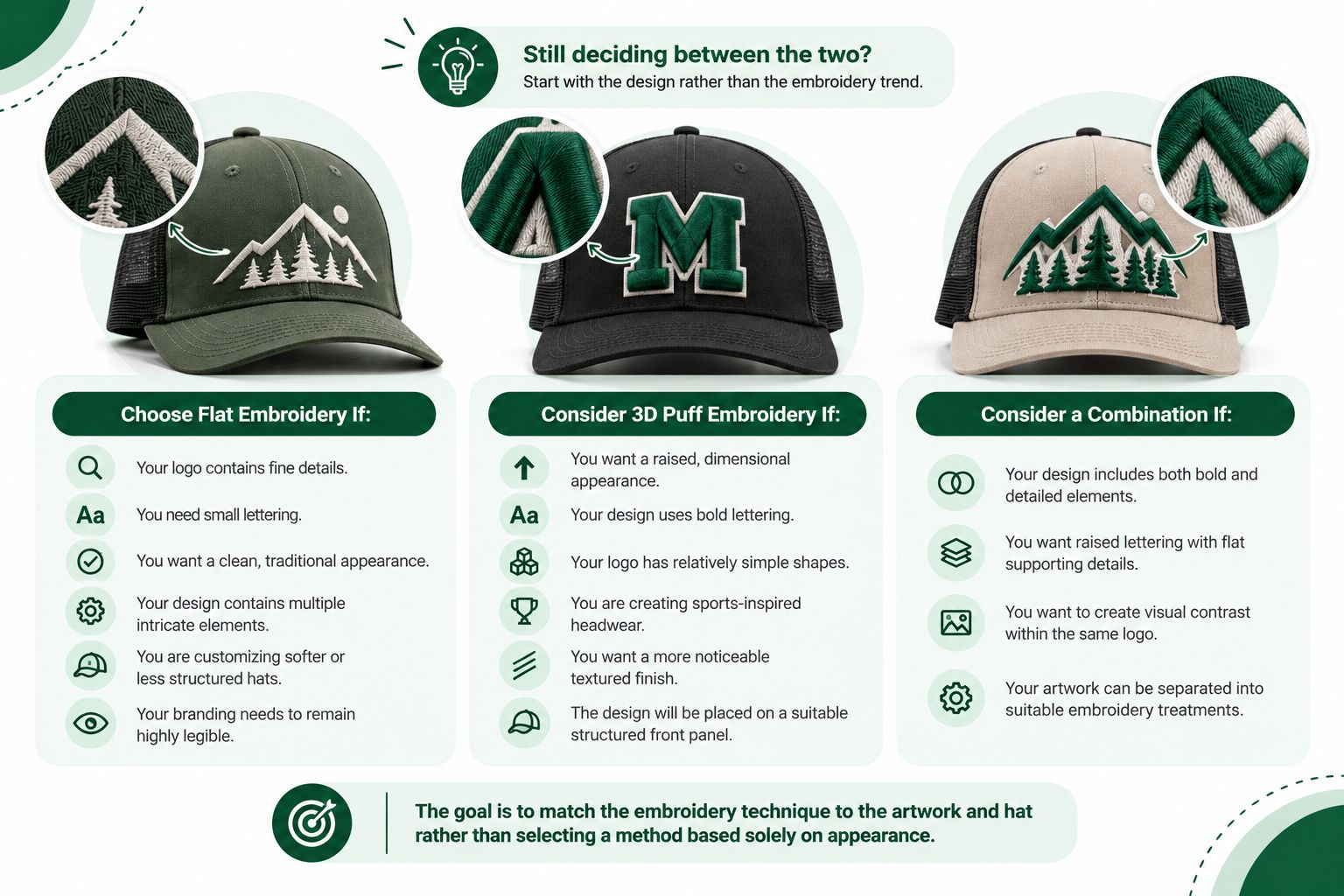
Still deciding between the two? Start with the design rather than the embroidery trend.
Choose Flat Embroidery If:
- Your logo contains fine details.
- You need small lettering.
- You want a clean, traditional appearance.
- Your design contains multiple intricate elements.
- You are customizing softer or less structured hats.
- Your branding needs to remain highly legible.
Consider 3D Puff Embroidery If:
- You want a raised, dimensional appearance.
- Your design uses bold lettering.
- Your logo has relatively simple shapes.
- You are creating sports-inspired headwear.
- You want a more noticeable textured finish.
- The design will be placed on a suitable structured front panel.
Consider a Combination If:
- Your design includes both bold and detailed elements.
- You want raised lettering with flat supporting details.
- You want to create visual contrast within the same logo.
- Your artwork can be separated into suitable embroidery treatments.
The goal is to match the embroidery technique to the artwork and hat rather than selecting a method based solely on appearance.
Related Hat Choices to Consider Before Ordering
Embroidery is important, but it is not the only decision that affects how a custom hat looks and performs.
Structured vs. Unstructured Caps
The crown construction affects the available embroidery surface and the overall appearance of the finished hat. Before choosing an embroidery technique, it can help to understand the difference between structured and unstructured caps.
Read structured vs. unstructured caps: what’s the difference? for a closer comparison.
5-Panel vs. 6-Panel Hats
Panel construction can influence where a logo can be placed and how much space is available for embroidery.
If you are still deciding on the cap construction, see 5-panel vs. 6-panel hat: a quick buyer’s guide.
Choosing a Custom Hat Supplier
When ordering custom embroidered hats, consider more than the quoted price. Look at:
- Available hat styles
- Embroidery capabilities
- Artwork and digitization process
- Experience with bulk orders
- Production quality
- Proofing process
- Turnaround expectations
- Customization options
For more guidance, see where is the best place to get custom hats made? or where to get custom hat embroidery bulk orders in the USA.
How to Prepare Your Artwork for Flat or 3D Embroidery
Good embroidery starts with artwork that is suitable for stitching. A design that looks great on a screen may need adjustments before it can be embroidered onto a hat.
Before production:
- Keep important design elements clear and recognizable.
- Avoid making small text unnecessarily tiny.
- Use bold shapes when creating a puff embroidery design.
- Consider the final embroidery size.
- Check how the design will fit on the chosen hat panel.
- Ask the embroidery provider to review and digitize the artwork.
- Review a digital proof before production begins.
Digitization is particularly important because embroidery software converts artwork into a stitch-based design. The final result depends not only on the original artwork but also on how that artwork is prepared for the specific hat and embroidery technique.
Common Mistakes to Avoid
Trying to Use 3D Puff on Highly Detailed Artwork
Puff embroidery needs sufficient space for the raised elements. Designs with excessive fine detail may lose clarity when converted into a dimensional format.
Making Small Text Too Tiny
Small lettering can become difficult to read once converted into stitches. If readability is important, consider increasing the text size or using flat embroidery.
Ignoring the Hat’s Structure
The same embroidery design may behave differently on a structured cap, soft dad hat, trucker hat, or flexible beanie.
Choosing a Style Based Only on Price
The least expensive option may not produce the appearance you want. Compare the complete project, including the hat, artwork preparation, embroidery method, quantity, and expected finish.
Not Reviewing a Digital Proof
A proof gives you an opportunity to check design size, placement, colors, lettering, and overall appearance before production.
Conclusion: Choosing Between Flat and 3D Embroidery for Hats
The choice between flat and 3D embroidery comes down to the relationship between your artwork, hat style, and desired appearance.
Flat embroidery provides a smooth, versatile finish and is generally well suited to detailed logos, fine lines, and smaller text. 3D puff embroidery creates a raised, dimensional effect that can make bold lettering and simple logos stand out.
If you are ordering custom embroidered headwear, consider the design first, then select a hat construction and embroidery method that support it. Hat.co can be one option to explore when planning custom hats for brands, teams, businesses, organizations, or other projects.
Frequently Asked Questions
Is flat embroidery or 3D embroidery better for hats?
Neither method is universally better. Flat embroidery can be suitable for detailed designs and smaller text, while 3D embroidery can work well for bold, simple designs where a raised appearance is desired.
What is the difference between flat embroidery and 3D puff embroidery?
Flat embroidery is stitched directly onto the hat and has a relatively level surface. 3D puff embroidery uses foam beneath the stitching to create a raised, dimensional effect.
Is 3D embroidery good for detailed logos?
3D embroidery is generally better suited to bold, uncomplicated designs. Highly detailed logos, fine lines, and very small text may be more suitable for flat embroidery.
What hats work best for 3D embroidery?
Structured hats with stable front panels are commonly suitable for 3D embroidery. The exact suitability depends on the hat construction, embroidery area, and artwork.
Does 3D embroidery last longer than flat embroidery?
Both techniques can be durable when properly produced and cared for. However, the foam used in 3D embroidery can compress over time, which may affect the raised appearance.
Can flat and 3D embroidery be used on the same hat?
Yes. Some designs can combine raised and flat embroidery to create contrast between dimensional lettering and detailed supporting elements.
Is 3D puff embroidery more expensive than flat embroidery?
It can be, depending on the design and production requirements. Foam, digitization, stitch count, hat type, quantity, and artwork complexity can all affect the final cost.