

Why Does the Embroidery Technique You Choose Matter So Much?
Choosing between logo vs text embroidery isn’t simply a design preference—it directly affects how your custom beanies look, how well they represent your brand, and how easily people remember them. Since beanies have a smaller decoration area than caps or hoodies, every stitch counts. Selecting the right embroidery approach ensures your design remains clear, balanced, and visually appealing.It Shapes Your Brand’s First Impression
Your embroidered design is often the first thing people notice. A logo embroidery on beanies creates an instantly recognizable visual identity, making it ideal for businesses, sports teams, and established brands. On the other hand, text embroidery on beanies works well when you want to highlight:- A company name
- A slogan
- A campaign message
- A club or event name
It Affects Readability
Beanies offer limited embroidery space, especially on folded cuffs. If your logo contains intricate details or your text uses thin lettering, the embroidery may become difficult to read. For better results:- Small logos should have bold, simplified shapes.
- Text should use thick, clean fonts.
- Avoid excessive detail that can disappear in stitching.
It Influences Stitch Quality
Embroidery machines recreate designs using thread—not ink. A complex logo with numerous fine elements requires more stitches, while simple text or bold icons usually produce cleaner embroidery. This impacts:- Stitch density
- Thread coverage
- Overall finish
- Long-term durability
It Supports Different Branding Goals
The best choice depends on how the beanie will be used. A logo embroidery on beanies is excellent for:- Corporate uniforms
- Employee apparel
- Premium merchandise
- Brand recognition
- Lifestyle brands
- Fashion collections
- Fundraisers
- Sports teams
- Personalized gifts
It Creates a Better Customer Experience
People buy custom beanies because they combine function with style. Well-planned embroidery makes the product feel higher quality while improving perceived value. If you’re designing premium custom beanies, selecting the right embroidery technique helps ensure customers receive products that not only keep them warm but also represent your brand professionally. Ultimately, deciding between logo vs text embroidery on beanies should always consider readability, branding goals, stitch quality, and available decoration space. The right embroidery technique ensures your custom beanies remain attractive, memorable, and effective as both fashion accessories and branding tools.Printed Logo vs Text Embroidery on Beanies: Decoding the Key Differences
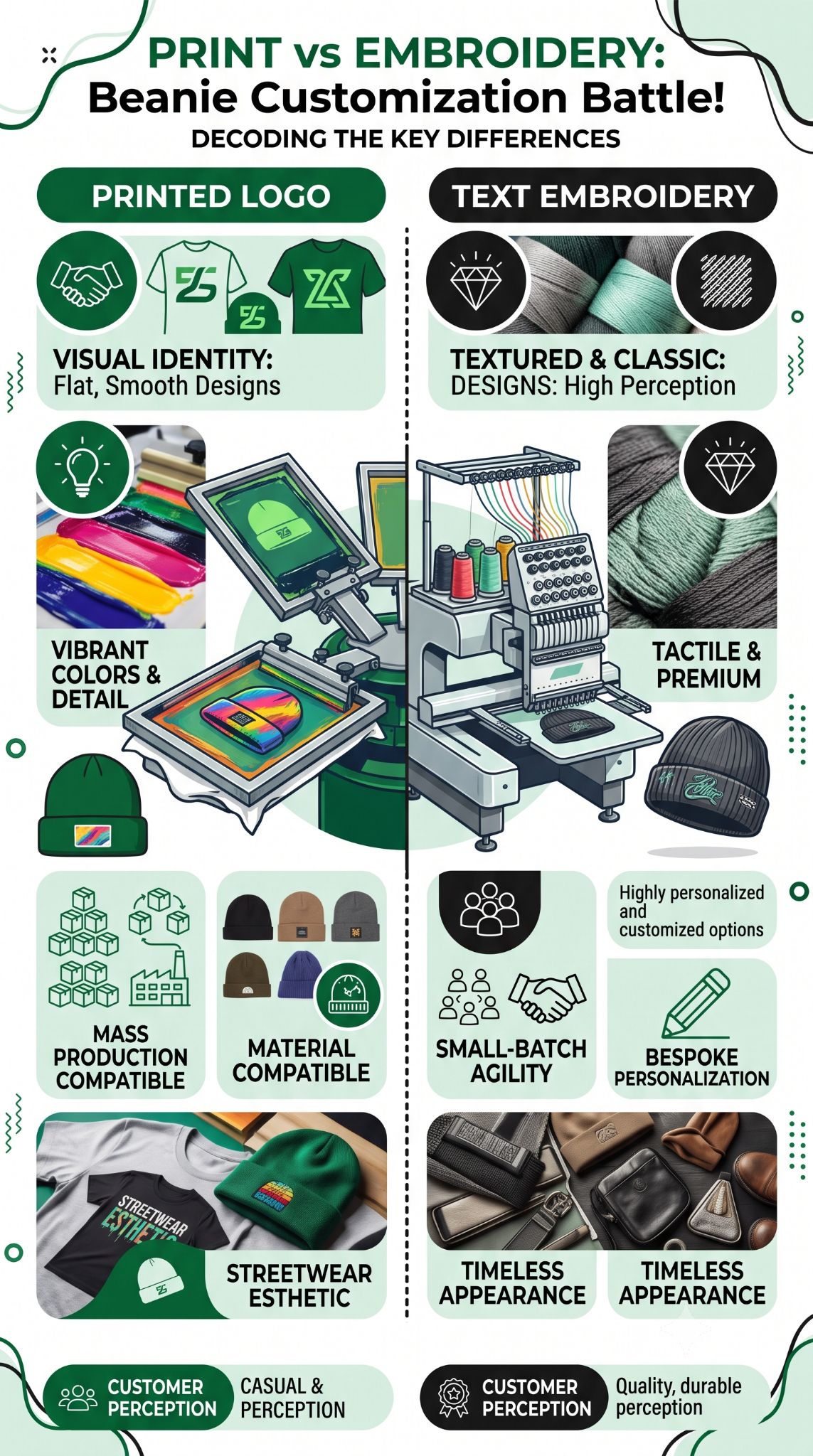
When designing custom embroidered beanies, one of the biggest decisions is whether to embroider a logo or use text as the primary design element. Both approaches serve different branding purposes and create different visual experiences. The right choice depends on your audience, the size of your artwork, and how the beanie will be used. Let’s compare logo vs text embroidery on beanies across the factors that matter most.Brand Recognition
A logo is a visual identity that people recognize instantly, while text communicates your message directly. Logo embroidery on beanies is ideal for:- Established businesses
- Sports teams
- Schools
- Corporate merchandise
- Lifestyle brands
Readability
Beanies offer a relatively small embroidery area, especially on folded cuffs. That means readability becomes critical. Logo embroidery performs best when:- The artwork is simple.
- Shapes are bold.
- Small details are removed.
- The design has strong contrast.
- Fonts are bold.
- Letter spacing is generous.
- The wording is short.
- Decorative scripts are avoided.
Visual Appeal
Different embroidery styles create different visual personalities. A logo generally creates:- Premium branding
- Professional appearance
- Clean aesthetics
- Long-term brand recognition
- Bold fashion statements
- Minimalist streetwear designs
- Personalized gifts
- Trend-focused merchandise
Stitch Complexity
Not every design stitches equally well. Logo embroidery may require:- Multiple stitch types
- Satin stitching
- Fill stitching
- Higher stitch counts
- Faster production
- Cleaner embroidery
- Better consistency across large orders
Flexibility Across Different Products
One major advantage of logos is versatility. The same embroidered logo used on a beanie can easily be applied to:- Flexfit hats
- Jackets
- Hoodies
- Polo shirts
- Bags
Fashion Trends
Current fashion trends heavily influence embroidery preferences. Many premium apparel brands now favor:- Small chest logos
- Minimal icons
- Tonal embroidery
- Clean branding
- Streetwear
- Collegiate apparel
- Outdoor brands
- Limited collections
Personalization
If your goal is customization, text usually wins. Text embroidery makes it easy to add:- Employee names
- Player names
- Initials
- Nicknames
- Event names
Production Efficiency
For larger orders, embroidery efficiency becomes important. Logo embroidery can increase production time if:- The design has many colors.
- Fine details require additional stitching.
- Multiple stitch directions are necessary.
Scalability Across Hat Styles
Not every hat offers the same embroidery space. A small embroidered logo adapts well to almost every headwear style, including snapback hats, because it remains readable even when resized. Large text designs often need adjustments to accommodate different crown heights and panel shapes. If you’re planning a complete branded collection, logos generally scale more easily.Customer Perception
Logos and text communicate different messages. Customers often associate logos with:- Professional brands
- Premium products
- Long-established businesses
- Trust and familiarity
- Friendly
- Expressive
- Personal
- Contemporary
Which Works Better for Small Businesses?
For newer brands, combining both approaches can be extremely effective. For example:- Embroider the logo on the front.
- Add the company name on the back.
- Include a slogan inside the cuff label.
What Works Best for Embroidered Beanies?
So, what works best for embroidered beanies? The answer depends on your goal. Choose logo embroidery if you want:- Strong visual branding
- Professional appearance
- Long-term recognition
- Consistent branding across products
- Immediate readability
- Personalized products
- Event merchandise
- Fashion-driven designs
Logo vs Text Embroidery on Beanies: Compared on Cost, Durability, and Brand Fit
Choosing between a logo and text for embroidered beanies isn’t only about appearance. It also affects production costs, long-term durability, and how effectively your brand connects with customers. While both options use the same embroidery process, their performance differs depending on the complexity of the artwork and the purpose of the finished product. Let’s compare them across the three factors that matter most.Cost
The cost of embroidery is determined by stitch count rather than whether the artwork is a logo or text. A simple company logo with bold shapes may actually cost less than a long business name stitched in multiple lines. Short text designs generally use fewer stitches because the embroidery follows straightforward paths. However, if the text contains several words, decorative fonts, or multiple colors, the stitch count increases quickly. Similarly, logo costs depend on design complexity. A minimalist icon may require only a few thousand stitches, while an intricate crest with detailed outlines and filled sections can significantly increase production time and pricing. The table below shows a general comparison.| Factor | Logo Embroidery | Text Embroidery |
| Simple design | Lower cost | Lower cost |
| Complex artwork | Higher cost | Moderate cost |
| Long wording | Not applicable | Higher cost |
| Multiple colors | Higher cost | Higher cost |
Durability
Embroidery is one of the most durable decoration methods available, but the structure of the design influences how well it performs over time. Simple logos tend to age exceptionally well because they use larger satin stitches and balanced fill areas. These stitches remain stable even after repeated washing and everyday wear. Highly detailed logos can be more vulnerable if very small elements are stitched close together. Dense stitching may create additional stress on knit fabrics, particularly when the beanie stretches during use. Text embroidery is generally durable when bold fonts are used. Thick lettering maintains its shape and remains readable after years of wear. Problems usually occur when thin fonts, decorative scripts, or extremely small letters are selected. Fine lettering can lose definition more quickly than bold typography. Overall, both options offer excellent durability when the artwork has been optimized specifically for embroidery.Brand Fit
The strongest factor separating logo and text embroidery is how each one supports your branding strategy. Logo embroidery focuses on recognition. Customers identify your brand through visual symbols, making logos ideal for companies with an established identity. A recognizable icon often communicates professionalism before a customer even reads the company name. Text embroidery, on the other hand, focuses on communication. It immediately tells people who you are, making it particularly effective for newer brands that are still building awareness. A clear business name or memorable slogan helps audiences connect the product with the company more quickly. Brand personality also plays an important role. Logo embroidery usually suits:- Corporate uniforms
- Premium merchandise
- Sports organizations
- Luxury apparel
- Streetwear brands
- Community organizations
- Local businesses
- Personalized gifts
- Event merchandise
| Branding Goal | Logo Embroidery | Text Embroidery |
| Instant brand recognition | Excellent | Moderate |
| Business name visibility | Moderate | Excellent |
| Professional appearance | Excellent | Very Good |
| Personalization | Limited | Excellent |
| Long-term brand building | Excellent | Good |
When Is Embroidery the Smart Choice?
Embroidery isn’t the right decoration method for every project, but it’s often the best option when durability, professionalism, and premium branding are the priorities. If you’re deciding between logo vs text embroidery, the intended use of the beanie can help guide your decision.Choose Logo Embroidery When…
Logo embroidery is the smarter choice if your goal is long-term brand recognition. It works particularly well for:- Corporate uniforms
- Employee winter apparel
- Sports teams
- School merchandise
- Retail collections
- Premium promotional products
Choose Text Embroidery When…
Text embroidery is ideal when your message is more important than your visual identity. It’s commonly used for:- Startup brands
- Event merchandise
- Personalized gifts
- Club or organization names
- Inspirational phrases
- Fashion-focused beanies
Choose Both for Maximum Impact
Many successful brands don’t choose one over the other—they combine both. For example:- Front: Small embroidered logo
- Back: Company name or slogan
- Side: Collection name or icon
Embroidery Is Best If You Need…
Embroidery is the smart choice when your project requires:- Long-lasting decoration
- Premium appearance
- Professional branding
- Excellent wash durability
- High perceived product value
- Consistent branding across multiple apparel products
When Is a Printed Logo the Smart Choice?
While embroidery is the preferred decoration method for premium beanies, a printed logo can be a better solution in certain situations. Printing allows for greater design flexibility and can reproduce artwork that embroidery simply can’t.Printed Logos Work Best for Highly Detailed Designs
If your logo contains:- Fine lines
- Small text
- Gradients
- Shadows
- Photographic elements
- Complex illustrations
Ideal for Full-Color Branding
Embroidery uses thread colors, which can limit color transitions and subtle shading. Printed logos are a smarter choice when your branding relies on:- Multiple colors
- Soft gradients
- Color blending
- Detailed artwork
Better for Large Graphic Designs
If the design covers a large portion of the beanie or wraps around multiple panels, printing often provides a cleaner result than dense embroidery. Large printed graphics also avoid the additional weight and stiffness that heavy embroidery can create.Suitable for Fashion-Driven Collections
Many lifestyle and streetwear brands choose printed logos because they allow for:- Trend-based graphics
- Seasonal artwork
- Artistic illustrations
- Bold typography
A Good Option for Budget-Conscious Projects
Printed decoration can be more economical for large, full-color graphics because it avoids high stitch counts and lengthy embroidery production. This makes it a practical choice for:- Promotional giveaways
- Limited-time campaigns
- Event merchandise
- Large-volume production with complex artwork
Best Applications for Printed Logos
Printing is an excellent choice when you need:- Highly detailed artwork
- Full-color graphics
- Photographic designs
- Large illustrations
- Fast-changing fashion collections
- Lower-cost decoration for complex graphics