

Key Takeaways
- Branded beanies combine practical warmth with visible brand exposure.
- They can be worn repeatedly during fall and winter instead of being used once.
- Promotional beanies work well for employees, customers, events, and outdoor teams.
- Embroidery, woven designs, and patches create different visual and tactile results.
- The best beanie depends on the audience, climate, budget, and intended use.
- A useful beanie can make promotional spending feel more like a product investment than a disposable giveaway.
Why Branded Beanies Work So Well as Promotional Items
Promotional merchandise has a simple problem: receiving an item does not mean someone will use it. A branded pen may sit in a drawer. A novelty item may be forgotten after an event. Apparel has a different advantage because it can become part of someone’s normal routine. Beanies have an especially clear use case when temperatures drop. Someone commuting to work, walking a dog, attending an outdoor event, or working outside may already have a reason to wear one. That changes the relationship between the product and the branding. Instead of asking someone to interact with an advertisement, the business provides something the recipient already needs.The practical value matters
A good promotional beanie should answer a simple question: Would the recipient want this if the logo were not there? If the answer is yes, the promotional element becomes secondary. That is a useful standard for almost any branded apparel campaign. The more useful the underlying product, the less the branding needs to do the heavy lifting.Branded Beanies Create Repeat Brand Visibility
The value of a promotional item is not limited to the moment it is handed over. A beanie can be worn repeatedly across a season. That means the same piece of merchandise may appear during commutes, outdoor activities, errands, workdays, sporting events, and casual outings. This creates repeated exposure without requiring the recipient to actively engage with a marketing message. The effect is particularly useful for businesses whose audiences spend time outdoors. Construction crews, event staff, delivery teams, outdoor organizations, sports groups, and field-service businesses can all have practical reasons to use winter headwear. A simple logo on the front cuff can remain visible every time the beanie is worn.Promotional Beanies Are Useful for Employees, Customers, and Events
One reason beanies are versatile is that the same basic product can serve several different promotional purposes. For employees, they can become part of seasonal workwear or a company apparel program. For customers, they can work as appreciation gifts or loyalty merchandise. For events, they can provide something more useful than another disposable giveaway.Common applications include:
- Employee winter gifts
- Seasonal uniforms
- Customer appreciation campaigns
- Holiday gifting
- Outdoor events
- Trade shows
- Team merchandise
- Retail merchandise
- Community programs
- Winter product launches
What Makes a Good Promotional Beanie?
Not every beanie is equally suitable for branding. The first consideration should be the intended wearer. Someone working outdoors may care most about warmth and durability. A lifestyle audience may care more about color and appearance. Employees may want something comfortable enough to wear for several hours.Look at these factors before choosing a style:
Material
Common choices include acrylic, cotton blends, polyester, wool blends, and performance fabrics. Each behaves differently. Acrylic is often chosen for its softness, stretch, and practical durability. Wool can offer warmth and a more premium feel, while performance fabrics may make sense for active or outdoor audiences.Construction
Cuffed, uncuffed, slouch, fisherman-style, and pom-top designs create very different impressions. A cuff also provides a natural location for a logo or other decoration.Color
The hat color needs to work with the branding. A dark logo on a dark beanie may lose definition. Conversely, excessive contrast can make the design feel disconnected from the rest of the brand identity. The goal is not necessarily exact color matching. It is clear visual hierarchy.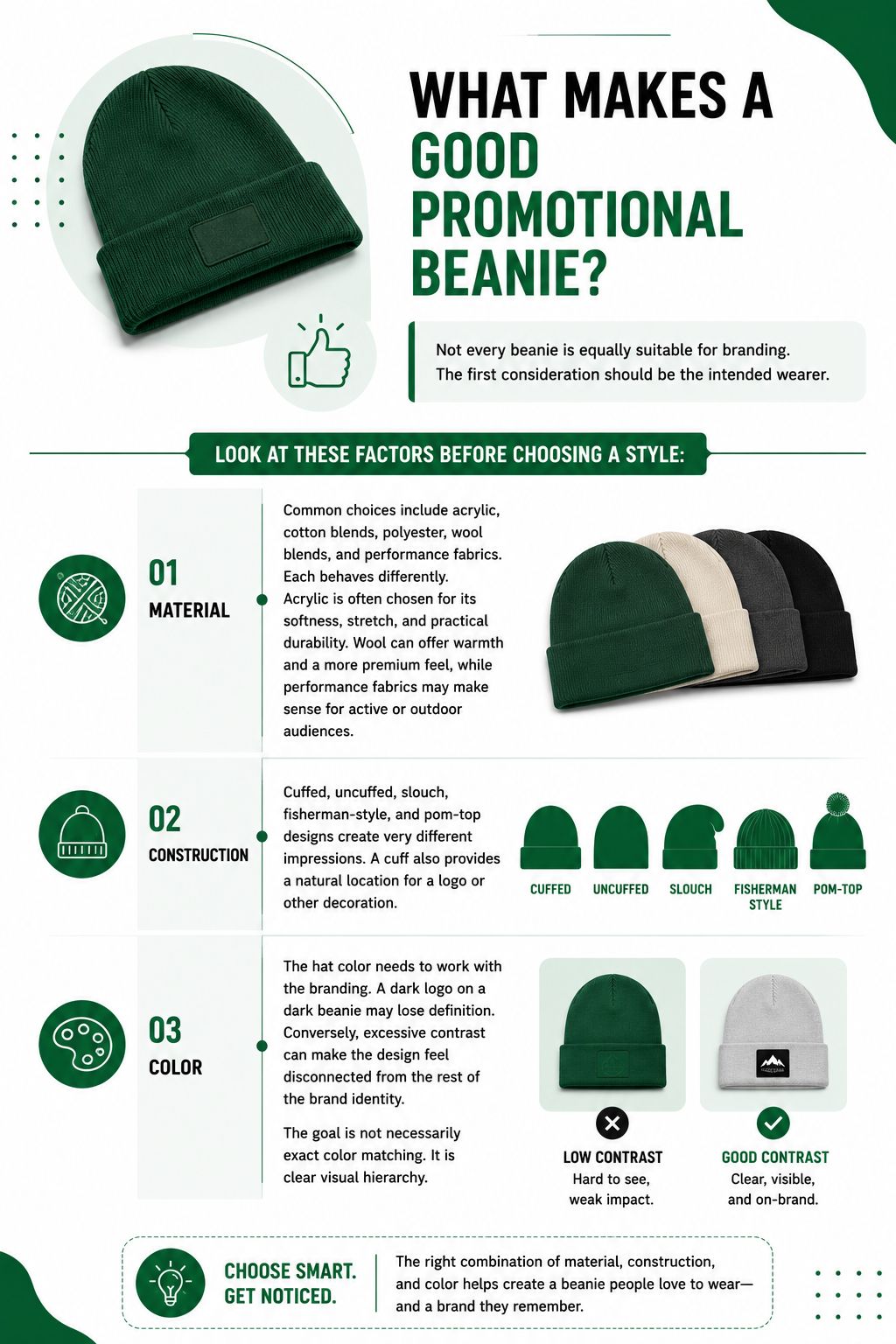
Custom Branded Beanies: Choosing the Right Decoration
Decoration deserves more attention than it usually receives. The same logo can look very different depending on how it is applied.Embroidery
Embroidery creates a stitched, textured appearance. It works particularly well when the design is relatively simple and needs a durable, classic finish. It can give custom branded beanies a more substantial feel without requiring an oversized graphic.Woven designs
Woven decoration can preserve smaller details because the design is incorporated into a woven label or construction rather than relying entirely on stitches. This can be useful for designs containing finer visual elements.Patches
Patches can introduce another layer of texture and can give a beanie a more merchandise-oriented appearance. They’re especially useful when the brand wants the decoration itself to become part of the design rather than simply placing a logo directly on the knit. Hat.co’s beanie service supports embroidered, woven, printed, and patch-based customization, giving businesses several ways to match decoration to the design and intended use.Why Custom Beanies for Business Need More Than a Logo
A common mistake is treating the logo as the entire design. A better approach is to think about how the finished beanie will look from several feet away. For example, a complex logo containing tiny text may technically fit on a cuff but become difficult to read once stitched into a stretchy knit fabric. A simpler mark may produce a much stronger result.Before production, consider:
- Logo complexity
- Decoration size
- Cuff height
- Thread or patch colors
- Contrast
- Hat color
- Intended viewing distance
- Brand personality
Branded Beanies for Promotions: When They Make Sense
The strongest campaigns usually connect the product to a specific reason for giving it away. For example, a winter employee appreciation campaign has a clear connection between the season and the product. An outdoor event has an even more direct connection. But giving away winter hats in a warm-weather campaign with no clear seasonal relevance may create less interest.Think about the campaign context:
Winter event: A natural fit. Outdoor workforce: A practical piece of apparel. Holiday employee gift: Useful and easy to personalize. Retail merchandise: Works when the design has enough standalone appeal. Trade show in cold weather: A practical alternative to generic promotional products. The product should feel like part of the campaign, not an unrelated object carrying a logo.Promotional Winter Hats vs. Other Branded Headwear
Beanies aren’t the only option. The right headwear depends heavily on weather and audience behavior. A warmer climate may call for lighter headwear. A summer event might be better suited to caps. A sports audience may prefer athletic construction. For example, Snapback hats can make more sense when adjustable sizing and a structured, casual look are more important than warmth. Likewise, Trucker hats can be useful when ventilation and a mesh-back construction are relevant to the audience. This comparison matters because a promotional product should match the environment in which it will actually be used.Branded Beanies for Promotions: How to Choose the Right Quantity
Quantity affects both budget and distribution strategy.Before ordering, determine whether the beanies are intended for:
- A small internal team
- A customer appreciation program
- A public event
- A retail launch
- A seasonal employee rollout
- A large promotional campaign
How to Make a Branded Beanie People Want to Wear
Useful merchandise still needs good design. A beanie that looks like a walking advertisement may have a lower wear rate than one where the branding feels integrated into the design. Keep the visual system simple.A strong approach might use:
- One recognizable logo
- Two or three coordinated colors
- A clean placement
- Appropriate decoration size
- A beanie style that matches the brand personality
When Premium Materials Are Worth the Extra Cost
Paying more for a beanie is not automatically a better investment. The question is whether the additional quality is noticeable to the recipient and useful for the intended application. For a client gift, premium materials may make sense because the perceived value of the item matters. For a large event giveaway, durability and price may matter more than luxury materials. For employees who will wear the beanie repeatedly, comfort can justify spending more because the item needs to survive regular use. Think about the entire lifecycle rather than just the purchase price. A cheaper beanie that nobody wants to wear is not necessarily cheaper from a marketing perspective.How Hat.co Approaches Custom Beanies
When a business needs branded headwear, the production process matters almost as much as the finished design. Hat.co’s current beanie service supports multiple decoration approaches, including embroidery, woven designs, printed designs, and patches. It also offers no-minimum ordering, bulk discounts, digital proofs, and a process that starts with choosing a style and ends with production and delivery. For businesses, that can be useful when the order isn’t completely standardized. A small organization may need a modest run, while a larger company may need thousands of units across a seasonal program. The important part is having the design, decoration, quantity, and timeline aligned before production begins.A Simple Checklist Before Ordering Branded Beanies
Before approving a promotional beanie order, check these eight points:
- Audience: Who will actually wear it?
- Climate: How cold will the intended environment be?
- Style: Does the construction match the brand?
- Material: Is it comfortable enough for repeated use?
- Decoration: Is embroidery, a patch, woven artwork, or printing most appropriate?
- Color: Does the logo remain clear against the hat?
- Quantity: Is the order sized around actual distribution?
- Proof: Has the final decoration been reviewed before production?