

Key Takeaways
- Fitted hats use specific numerical sizes for a precise fit.
- Snapbacks use adjustable snaps and are easier to share or gift.
- Fitted hats generally provide a cleaner closed-back appearance.
- Snapbacks offer more flexibility when head size or hairstyle changes.
- Crown profile and construction can matter as much as the closure.
- Neither style is universally better; the right choice depends on use.
Fitted Hats vs Snapbacks: The Fundamental Difference
The simplest difference between fitted hats and snapbacks is the closure. A fitted hat has a completely closed rear. Instead of using snaps, it is manufactured to fit a particular head circumference. The wearer normally chooses a numerical size, such as 7, 7 1/4, or 7 5/8. A snapback has an adjustable closure, typically made from two interlocking rows of plastic snaps. Rather than selecting one precise numerical size, the wearer adjusts the closure until the hat feels comfortable. That creates two different ownership experiences:Fitted Hats vs. Snapback Hats
Compare sizing, fit, adjustability, and everyday use to find the right hat style for your needs.
| 🎯 Feature | 🧢 Fitted | ⚡ Snapback |
|---|---|---|
| Rear Closure | Closed | Adjustable snaps |
| 📏 Sizing | Numerical sizes | Adjustable |
| 🎯 Precision | High | Flexible |
| 👥 Sharing | Difficult | Easy |
| 📐 Size Selection | Important | Less critical |
| 🔙 Back Appearance | Clean, closed back | Visible closure |
| 🏆 Common Use | Sports, collecting, fitted looks | Casual wear, streetwear, branding |
| 🎁 Gifting | Requires recipient’s size | Easier because of adjustable sizing |
💡 Quick Tip:
Choose fitted hats when precise sizing and a clean, structured appearance are priorities. Choose snapbacks when adjustability, easy gifting, or flexible sizing matters most.
What Is a Snapback Hat?
Snapback hats are adjustable caps designed to accommodate a range of head sizes. Their biggest practical advantage is convenience. If you buy a snapback online, you don’t necessarily need to know your exact fitted size before purchasing. You can adjust the closure after receiving the hat. This makes snapbacks particularly useful for:- Gifts
- Team merchandise
- Event giveaways
- Casual wardrobes
- Shared household use
- People whose preferred fit changes
- Buyers uncertain about numerical sizing
What Is a Fitted Hat?
A fitted hat does not have an adjustable opening at the back. Instead, its circumference is manufactured to a specific size, creating a more precise and consistent relationship between the hat and the wearer’s head. The main advantage is consistency. Once you know your correct size, a properly manufactured fitted cap can feel secure and stable without relying on a rear closure. The fixed construction also creates a continuous back panel, which gives the hat a clean, streamlined appearance. For wearers who prefer a structured fit and a consistent silhouette, this construction can offer a more tailored feel than adjustable designs.Fitted Hats vs Snapback Hats: Which Fits Better?
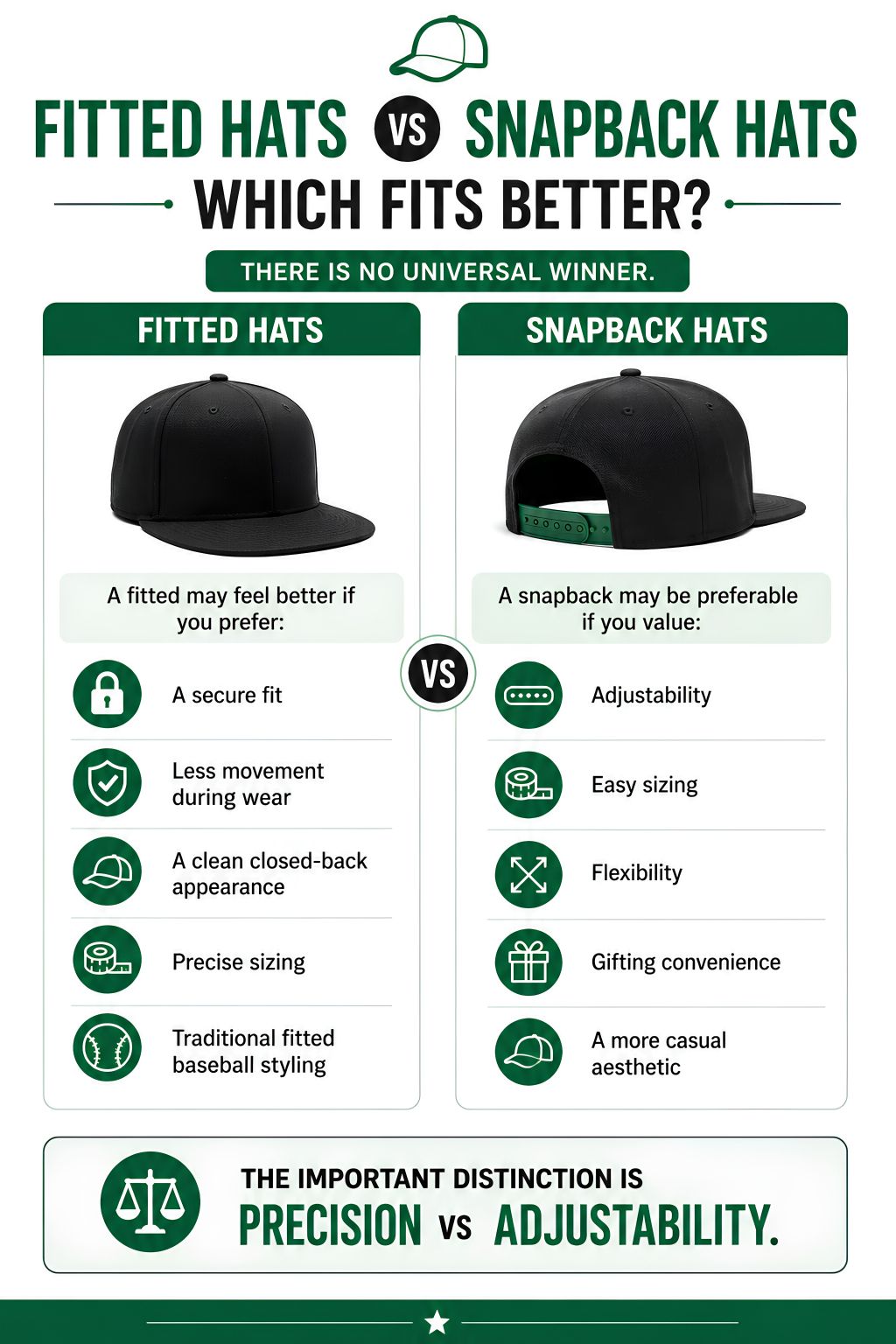
There is no universal winner. A fitted may feel better if you prefer:- A secure fit
- Less movement during wear
- A clean closed-back appearance
- Precise sizing
- Traditional fitted baseball styling
- Adjustability
- Easy sizing
- Flexibility
- Gifting convenience
- A more casual aesthetic
Fitted Hat vs Snapback: How Sizing Works
Sizing is where the two styles behave very differently. With a fitted hat, measure around the head where the sweatband will sit—normally just above the eyebrows and around the widest part of the head. Convert the circumference to the manufacturer’s size chart. With a snapback, exact measurement is less important because the rear closure provides a range of adjustment. However, “one size fits most” does not mean “one size fits everyone.” Head shape, crown depth, panel construction, and how tightly the wearer likes the hat can still affect comfort.Snapback vs Fitted Size Chart
There is no universal one-to-one conversion because snapback adjustment positions vary by manufacturer and hat model. As a practical reference, fitted sizes commonly progress in 1/8-size increments:Fitted Hat Size Chart
Use your head circumference to find the fitted hat size that should provide the closest fit.
| 🧢 Fitted Size | 📏 Approx. Head Circumference |
|---|---|
| 6 7/8 | 21 1/2″ |
| 7 | 21 7/8″ |
| 7 1/8 | 22 1/4″ |
| 7 1/4 | 22 5/8″ |
| 7 3/8 | 23″ |
| 7 1/2 | 23 1/2″ |
| 7 5/8 | 24″ |
| 7 3/4 | 24 3/8″ |
| 7 7/8 | 24 3/4″ |
| 8 | 25″ |
💡 Sizing Tip:
Measure around the widest part of your head, keeping the measuring tape level and comfortably snug. For fitted hats, check the specific manufacturer’s size chart before ordering because sizing can vary slightly between brands and styles.
Snapback vs Fitted: Crown Shape Matters
Two hats can have the same basic closure category and still look and feel completely different. The crown is the portion of the hat that surrounds the top and sides of your head. Its profile can be:- Low profile
- Mid profile
- High profile
- Structured
- Unstructured
Fitted Hats vs Snapbacks: Comfort Comparison
Comfort depends heavily on the individual. A fitted hat may feel more comfortable because there is no snap closure pressing against the back of the head. It can also stay stable during movement when correctly sized. A snapback can feel more comfortable because the wearer can loosen or tighten it throughout the day. Consider your environment. If you’re wearing a cap casually for several hours, adjustability may matter most. If you’re wearing one while playing sports, collecting premium team caps, or maintaining a particular silhouette, a secure fitted may be more appealing. Neither construction guarantees comfort. An incorrectly sized fitted hat can be uncomfortable, while an aggressively tightened snapback can also create pressure.Men Fitted Hats vs Snapback Hats: Does Head Shape Matter?
Yes. Head circumference alone does not completely determine fit. Two people can have similar measurements but different head shapes. Some heads are:- Longer front-to-back
- Wider side-to-side
- More rounded
- More oval
Fitted Hats vs Snapback Hats for Sports: Which Is More Authentic?
Fitted hats have a long-standing association with sports headwear because their fixed sizing creates a precise, structured fit. This construction is often favored by people who want a more consistent, streamlined appearance. Snapbacks are also widely used for sports merchandise, fan apparel, and streetwear. Their adjustable closure makes them easier to share, size, and customize across different wearers. The key distinction is construction and fit, not authenticity. A fitted cap uses a fixed circumference, while a snapback uses an adjustable rear closure. Both can serve as legitimate sports-inspired headwear, with the better choice depending on the desired fit, adjustability, appearance, and intended use. In other words, snapbacks are not separate from the broader sports cap category. They are one of several construction styles used for sports headwear.Snapback vs Fitted: Style and Streetwear
Streetwear has embraced both styles. Fitted hats can create a cleaner, more deliberate silhouette. Snapbacks can create a more relaxed, adjustable look and are often paired with oversized apparel, sneakers, jerseys, and casual outerwear. Your choice can therefore depend on the rest of the outfit. Choose a fitted cap when the hat should look like a deliberate part of the silhouette. Choose a snapback when you want the cap to feel more casual, flexible, or retro. Style preferences often reflect the same distinction: snapbacks emphasize flexibility and casual styling, while fitteds emphasize structure and a more tailored finish.Fitted Hats vs Adjustable Hats: Which Is More Convenient?
Adjustable hats win on convenience. If you’re purchasing hats for a group, you may not know everyone’s exact size. Ordering multiple fitted sizes can create more inventory complexity. Snapbacks simplify that problem. They can work especially well for:- Company merchandise
- Sports fan giveaways
- Events
- Promotional campaigns
- Family purchases
- Online stores
Snapback vs Adjustable: Are They the Same?
Not exactly. “Adjustable“ describes a broader category of hats that use some type of closure to change the fit. A snapback is one specific type of adjustable hat, typically recognized by its segmented snap closure at the back. Other adjustable closure systems can include:- Hook-and-loop straps
- Buckle closures
- Fabric straps
- Metal clasps
What About Flex-Fit Hats?
Flex-fit hats sit between traditional fitted and adjustable designs. Instead of using snaps, they use stretchable material around the opening. This can provide a snug feel without requiring a precise numerical fitted size. Flexfit hats are worth considering if you want a cleaner rear appearance than a snapback but still want some sizing flexibility. For many buyers, the decision is therefore not simply “fitted or snapback.” The real choice may be among fitted, snapback, strapback, flex-fit, and other adjustable constructions.Fitted Hats vs Snapbacks: Durability and Long-Term Wear
Durability depends more on materials and construction than closure type alone. Look at:- Fabric quality
- Sweatband construction
- Stitching
- Crown structure
- Visor construction
- Closure quality
- Embroidery
- Care instructions
Which Is Better for Collectors Between Fitted Hats and Snapback Hats?
Fitted hats can appeal strongly to collectors because their fixed sizing and structured silhouettes are often associated with specific sports, fashion, and streetwear releases. Limited-edition patches, team designs, collaborations, and exclusive colorways can also increase the appeal of particular fitted caps. However, collectability is not determined by the closure style alone. A limited-release snapback can be more desirable than a widely available fitted hat, depending on factors such as rarity, design, condition, edition, and demand. For collectors, the better approach is to evaluate the specific hat and release rather than assuming fitted hats are automatically more valuable. A snapback can offer just as much collector appeal when its design, availability, or cultural significance makes it distinctive.Are Fitted Hats Better Than Snapbacks?
Only if their advantages match your priorities.Choose fitted if you want:
- Precise sizing
- A clean closed back
- Secure wear
- Traditional fitted baseball styling
- Collector-oriented releases
- A tailored silhouette
Choose snapback if you want:
- Adjustable sizing
- Easy gifting
- Flexible comfort
- Casual styling
- Group-friendly sizing
- Easy accommodation for hairstyle changes
Choose flex-fit if you want:
- Stretch
- A cleaner rear
- A snug feel
- Less dependence on numerical sizing