

Key Takeaways
- A structured cap has reinforced front panels that help the crown hold its shape.
- An unstructured cap has little or no stiffening, giving it a softer and more relaxed appearance.
- Structure and profile are different: a cap can be low-profile and structured.
- Structured caps usually create a more defined front panel for prominent decoration.
- Unstructured caps generally feel softer and conform more closely to the head.
- The best choice depends on fit, comfort, appearance, decoration, and intended use.
What Is a Structured Cap?
A structured cap uses some form of reinforcement behind the front panels of the crown. This support helps the cap maintain its shape when it is sitting on a table, hanging on a rack, or being worn. The reinforcement can vary by construction. A common approach uses a stiffened fabric such as buckram, although manufacturers may use other materials or construction methods. The important point isn’t the name of the reinforcement. It’s what that reinforcement does. It creates a firmer front that doesn’t collapse easily. That gives the cap a more defined silhouette and makes the front panel behave more like a stable surface than a loose piece of fabric. A structured design can be useful when you want the cap to look consistent from one wearer to another. This is one reason structured construction is common in team, business, event, and branded headwear.What Is an Unstructured Cap?
An unstructured cap has little or no stiff reinforcement supporting the front panels. Instead of maintaining an upright crown, the fabric can bend, fold, and conform more naturally to the wearer’s head. When you take an unstructured cap off and place it on a flat surface, the crown will usually relax rather than standing upright. This creates the softer appearance many people associate with casual caps and relaxed everyday headwear. The construction can also make an unstructured cap easier to pack and store because the crown doesn’t need to maintain a rigid shape. For travel or everyday use, that flexibility can be a genuine advantage. The trade-off is equally straightforward: if you want a crisp, upright front, an unstructured cap will not give you the same visual effect.Structured Cap vs Unstructured Cap: The Core Differences
The easiest way to understand the difference is to compare how each construction behaves.Structured Cap vs. Unstructured Cap
Compare crown construction, appearance, decoration options, and ideal uses to choose the right cap style.
| ✨ Feature | 🧢 Structured Cap | 🧢 Unstructured Cap |
|---|---|---|
| Front Panels | Reinforced | Soft and flexible |
| Crown Shape | Holds its form | Follows the head |
| Overall Appearance | Defined and crisp | Relaxed and casual |
| Typical Profile | Often mid or high, but varies | Often low, but varies |
| Packing | Less flexible | Generally easier |
| Front Decoration | Stable decoration surface | Softer decoration surface |
| Feel | More structured | More relaxed |
| Best For | Uniforms, teams, branded programs | Casual wear, lifestyle, everyday use |
Quick Tip:
Choose a structured cap for a crisp, defined appearance and a stable front surface for branding. Choose an unstructured cap if you prefer a softer, more relaxed fit for casual and everyday wear.
The Difference Between Structured and Unstructured Hats Is Not the Same as Profile
One of the most common shopping mistakes is treating “structured” and “low-profile” as opposites. They aren’t. Structure describes internal support. Profile describes crown height. A low-profile cap can still have reinforced front panels. Likewise, an unstructured cap can have a crown that isn’t extremely shallow. Why does this matter? Imagine someone wants a cap that sits relatively close to the head but still has a clean front for decoration. They don’t necessarily need to choose an unstructured design. A low-profile structured option may provide the combination they’re looking for.So when comparing caps, look at at least four separate characteristics:
- Structure: Does the front hold its shape?
- Profile: How tall is the crown?
- Closure: How does the cap adjust?
- Fit: How does it sit around the head?
How Structure Changes the Fit and Feel
The construction affects how the cap interacts with your head, particularly around the forehead and front crown. A structured cap generally feels more defined because the front doesn’t collapse toward the forehead as easily. Some people like that stable feeling, while others prefer a softer cap that settles naturally around their head. An unstructured cap usually feels less rigid. The front fabric can conform to the wearer rather than maintaining a predetermined shape. This doesn’t mean that every structured cap is uncomfortable or every unstructured cap is more comfortable. Materials, sweatband construction, crown depth, sizing, and closure all influence comfort. For example, someone with a larger head may find a shallow unstructured cap more restrictive than a deeper structured design. Someone who dislikes a tall crown may have the opposite preference. Fit should therefore be evaluated separately from structure.Structured vs Unstructured Caps for Logo and Embroidery
Decoration is another reason the distinction matters. A structured front gives embroidery and other decoration a more stable surface. Because the fabric is supported, the front panel is less likely to collapse or deform while the decoration is being applied.That can be especially useful for:
- Business logos
- Team identifiers
- Event branding
- Bold lettering
- Simple graphic marks
- Uniform headwear
When Should You Choose a Structured Cap?
Choose a structured design when the shape of the front is part of the look you want. It is particularly useful when the cap needs to look consistent, defined, or more formal.Common situations include:
- Employee or team uniforms
- Corporate events
- Sports-related apparel
- Branded merchandise
- Promotional campaigns
- Retail collections where a crisp silhouette is important
When Should You Choose an Unstructured Cap?
An unstructured cap makes more sense when comfort, flexibility, and a relaxed appearance are the priority.It can work particularly well for:
- Everyday casual wear
- Lifestyle merchandise
- Outdoor leisure
- Travel
- Relaxed uniforms
- Minimal branding
- Vintage-inspired designs
Different Uses for Structured and Unstructured Hats
There isn’t a single winner because different situations call for different characteristics.For business branding
Structured caps often have an advantage when a company wants a consistent, prominent presentation.For casual merchandise
Unstructured caps can feel more natural and less formal, which may suit lifestyle-oriented branding.For sports and teams
Either can work. Consider whether you want a defined athletic silhouette or a softer everyday fit.For outdoor use
Look beyond structure. Fabric, ventilation, brim shape, sweat management, and sun coverage may matter more than whether the crown is structured.For travel
Unstructured caps generally have an advantage because they can be packed more easily without fighting against a rigid crown.Does Structure Affect How a Hat Looks on Your Head?
Yes, but not by itself. A structured cap tends to create more visual height and definition at the front. It can make the crown appear more upright and deliberate. An unstructured cap usually sits closer to the head and produces a softer outline. But crown height, brim shape, panel count, and closure can change that impression significantly. For example, two six-panel caps can have completely different appearances even if one is structured and the other is not. One might have a deeper crown and curved brim, while the other has a shallow crown and a different closure. That’s why product descriptions should be read as a group rather than using a single label to predict the entire fit.Structure, Closure, and Material Should Be Considered Together
Structure tells you how the crown holds itself. It doesn’t tell you how the hat adjusts. A structured cap may have:- A snap closure
- A strap
- A buckle
- A stretch-fit construction
How to Choose Between Structured and Unstructured Caps
If you’re still unsure, start with the outcome rather than the terminology. Ask yourself: Do I want the cap to hold its shape when I take it off? Choose structured. Do I want the crown to follow my head naturally? Choose unstructured. Do I want a strong, visible front for branding? Structured is often the easier starting point. Do I want a softer, casual appearance? Unstructured is usually the better match. Will I travel with the cap frequently? An unstructured construction may be more convenient. Is comfort the main priority? Look beyond structure and compare crown depth, material, sweatband, closure, and sizing. Do I want a familiar everyday silhouette? A conventional baseball caps category gives you many construction options, so check the specific crown and profile rather than assuming every baseball cap is structured.Common Mistakes When Comparing Cap Construction
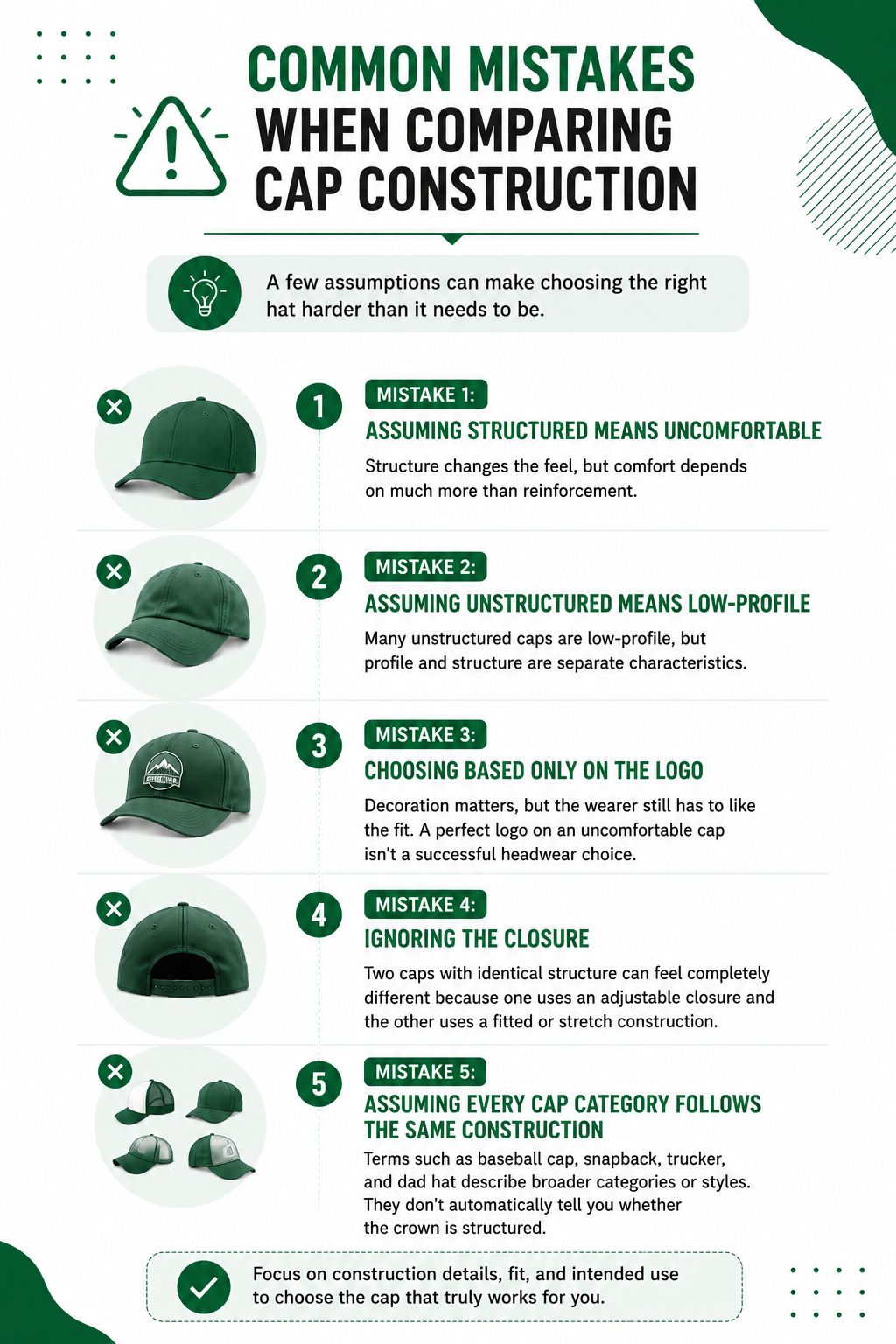
A few assumptions can make choosing the right hat harder than it needs to be.Mistake 1: Assuming structured means uncomfortable
Structure changes the feel, but comfort depends on much more than reinforcement.Mistake 2: Assuming unstructured means low-profile
Many unstructured caps are low-profile, but profile and structure are separate characteristics.Mistake 3: Choosing based only on the logo
Decoration matters, but the wearer still has to like the fit. A perfect logo on an uncomfortable cap isn’t a successful headwear choice.Mistake 4: Ignoring the closure
Two caps with identical structure can feel completely different because one uses an adjustable closure and the other uses a fitted or stretch construction.Mistake 5: Assuming every cap category follows the same construction
Terms such as baseball cap, snapback, trucker, and dad hat describe broader categories or styles. They don’t automatically tell you whether the crown is structured.