

Quick Answer: Embroidery vs Patches vs DTF for Hats
When comparing embroidery vs patches vs DTF for hats, there isn’t a single “best” option—it depends on your design and goals.- Embroidery is ideal for premium branding, durability, and classic logos.
- Patches work best for detailed artwork, vintage aesthetics, and textured finishes.
- DTF is the strongest choice for full-color, photo-quality graphics and intricate designs that embroidery cannot reproduce.
Embroidery for Hat Decoration
Embroidery has long been considered one of the best custom hat decoration methods because it creates a premium, textured finish that looks professional and lasts for years. Instead of printing artwork onto the surface, embroidery stitches colored thread directly into the hat, producing a raised design that withstands regular wear, washing, and outdoor use.How Does Embroidery Work?
The logo or artwork is first converted into a digital embroidery file through a process called digitizing. This file instructs the embroidery machine where each stitch should be placed, including stitch direction, density, and thread sequence. The machine then recreates the design using precision stitching. Embroidery works especially well on structured hats like trucker hats because their firm front panels provide a stable surface for clean, consistent stitching. This makes embroidered hats ideal for business branding, retail merchandise, uniforms, and promotional apparel where durability and premium appearance matter.Pros and Cons of Embroidery for Hat Decoration
| Pros | Cons |
| Creates a premium, textured finish that enhances perceived product value. | Fine details, tiny text, and gradients are difficult to reproduce accurately. |
| Extremely durable with excellent resistance to washing, fading, and everyday wear. | Usually costs more than DTF for highly detailed multi-color artwork. |
| Produces a professional appearance that is ideal for corporate branding and retail merchandise. | Thick embroidery can add slight weight and stiffness to the front panel. |
| Offers specialty options like flat embroidery and 3D puff embroidery for added visual depth. | Digitizing is required before production, adding an extra preparation step. |
| Works exceptionally well for logos, initials, icons, and bold typography. | Not suitable for photo-realistic graphics or complex illustrations. |
| Maintains consistent quality across large production runs, making it ideal for branded merchandise. | Artwork often requires simplification to meet embroidery thread limitations. |
DTF Transfers for Hat Decoration
DTF (Direct-to-Film) has emerged as one of the most versatile hat customization techniques, especially for designs that traditional embroidery cannot reproduce. Instead of stitching thread into the fabric, DTF prints the artwork onto a special film using water-based inks and adhesive powder. The design is then heat pressed onto the hat, creating a vibrant, full-color finish with excellent detail. This makes DTF transfers for hats ideal for logos with gradients, fine text, photo-quality graphics, or complex illustrations that would be difficult or impossible to embroider.How Do DTF Transfers Work?
The artwork is first printed in reverse onto PET film, coated with adhesive powder, and cured. Using a heat press, the transfer is then permanently bonded to the front panel of the hat. DTF works particularly well on smooth, structured styles like snapback hats and can also be applied to softer profiles such as dad caps when the correct heat settings are used. Because it reproduces intricate artwork without stitch limitations, DTF is becoming increasingly popular for fashion brands, promotional products, and short-run custom headwear.Pros and Cons of DTF Transfers for Hat Decoration
| Pros | Cons |
| Produces vibrant full-color prints with excellent detail and gradients. | Less textured and premium-looking than embroidery for luxury branding. |
| Perfect for photo-quality artwork, fine text, and complex logos. | Heat application must be carefully controlled to avoid damaging certain hat materials. |
| No digitizing is required, reducing setup time for new designs. | Large transfers may slightly reduce breathability on the decorated area. |
| Cost-effective for small orders and multi-color artwork. | Surface may feel slightly raised compared to printed garments. |
| Consistent reproduction across repeated production runs. | May not achieve the same high-end appearance as embroidered logos for corporate merchandise. |
| Works well for detailed branding where thread limitations would reduce design quality. | Not ideal for hats with heavily textured or uneven front panels. |
Custom Patches for Hat Decoration
Custom patches have become one of the most popular custom hat decoration methods for brands looking to create distinctive, premium-looking headwear. Instead of decorating the hat directly, the design is first produced as a separate patch and then attached using stitching, heat pressing, or industrial adhesives. Available in embroidered, woven, leather, suede, PVC, and silicone options, custom patch hats offer a unique combination of texture, depth, and visual appeal that instantly elevates the finished product.How Do Custom Patches Work?
The artwork is manufactured as an individual patch using the chosen material and backing. Once complete, the patch is securely attached to the front panel of the hat through sewing or heat application, depending on the patch type. This method works exceptionally well on structured styles like baseball caps because the firm crown provides a stable surface for accurate placement. Custom patches are especially valuable for heritage brands, outdoor companies, workwear collections, breweries, and lifestyle labels that want a handcrafted, high-end aesthetic while maintaining excellent durability.Pros and Cons of Custom Patches for Hat Decoration
| Pros | Cons |
| Creates a premium, dimensional appearance that stands out from standard decoration methods. | Usually costs more than direct embroidery or DTF due to separate patch production. |
| Available in multiple materials including embroidered, woven, leather, PVC, and silicone. | Adds an additional manufacturing step before final hat assembly. |
| Excellent for highly detailed logos and unique brand aesthetics. | Patch edges may lift if low-quality adhesives or improper application methods are used. |
| Easy to maintain consistent branding across hats, jackets, bags, and apparel. | Larger patches can add extra weight to the front panel. |
| Damaged patches can sometimes be replaced without replacing the entire hat. | Fine placement accuracy is critical to maintain a professional appearance. |
| Offers strong durability with excellent resistance to wear when properly attached. | Some premium patch materials require specialized equipment for attachment. |
Embroidery vs Patches vs DTF for Hat Decoration: An End-to-End Comparison
Selecting between embroidery vs patches vs DTF for hats depends on far more than appearance. Each decoration method offers distinct advantages in durability, design flexibility, production efficiency, and overall brand perception. Understanding these differences helps businesses choose the right custom hat decoration methods for their audience, artwork, and budget.| Comparison Factor | Embroidery | Custom Patches | DTF Transfers |
| Overall Appearance | Creates a premium, textured, stitched finish that immediately communicates quality. | Offers a bold, dimensional look with leather, woven, embroidered, PVC, or silicone options. | Produces vibrant, smooth, full-color graphics with photo-quality detail. |
| Design Complexity | Best for simple logos, bold icons, and clean typography. Small details and gradients are limited. | Handles moderate to highly detailed designs depending on patch material. | Excellent for intricate artwork, gradients, photographs, and fine text. |
| Brand Perception | Most commonly associated with luxury merchandise, corporate branding, and retail-quality embroidered hats. | Provides a distinctive handcrafted appearance that works well for premium lifestyle and heritage brands. | Creates a modern graphic aesthetic ideal for fashion, promotional products, and creative branding. |
| Durability | Outstanding. Thread remains intact through years of wear and repeated washing. | Extremely durable when professionally attached using stitching or industrial adhesives. | Highly durable when applied correctly, although long-term wear depends on transfer quality and application. |
| Wash Resistance | Excellent. Maintains appearance with minimal fading or wear. | Excellent, especially stitched patches. Heat-applied patches also perform well when properly attached. | Very good, although repeated washing may eventually affect heavily used graphics. |
| Texture & Feel | Raised stitched texture with a premium tactile finish. | Thick, dimensional surface that adds depth and character. | Smooth finish with minimal texture compared to thread or patches. |
| Best Artwork Type | Logos, initials, emblems, monograms, and corporate branding. | Vintage badges, outdoor branding, premium labels, and decorative artwork. | Full-color logos, illustrations, photo prints, and complex graphics. |
| Material Compatibility | Performs best on structured hats with stable front panels. | Compatible with most structured hats regardless of fabric type. | Works best on smooth front panels that tolerate heat application. |
| Production Speed | Requires digitizing before production but scales efficiently afterward. | Two-stage production (patch manufacturing plus attachment) increases lead time. | Fast setup with no digitizing, making it efficient for short production runs. |
| Cost Efficiency | Most economical for simple logos and larger production quantities. | Higher cost due to separate patch production and attachment process. | Cost-effective for multi-color artwork and low-volume custom orders. |
| Customization Options | Flat embroidery and 3D puff embroidery available. | Wide selection of embroidered, woven, leather, suede, PVC, and silicone patches. | Unlimited colors and highly detailed graphics without stitch limitations. |
| Ideal Use Cases | Company uniforms, retail merchandise, sports teams, and premium promotional products. | Outdoor brands, breweries, workwear, fashion labels, and heritage-inspired collections. | Creative fashion brands, event merchandise, limited editions, and promotional campaigns requiring detailed artwork. |
Which Option Is Right for Your Project?
If your primary goal is creating timeless, professional branding, embroidered hats remain the safest choice. They deliver exceptional durability, premium texture, and long-term brand value, making them ideal for corporate merchandise, uniforms, and retail collections. If you want your hats to stand out with a unique tactile finish, custom patch hats provide unmatched versatility. Leather patches create rugged sophistication, woven patches reproduce intricate artwork, while PVC and silicone patches offer bold, modern aesthetics that immediately capture attention. For artwork that includes gradients, photographs, highly detailed illustrations, or colorful branding, DTF transfers for hats outperform traditional stitching methods. They allow businesses to reproduce virtually any design without simplifying artwork for thread limitations. Ultimately, there is no universal winner in the embroidery vs patches vs DTF for hats debate. The best decision depends on your artwork, target audience, production volume, and desired brand image. Many successful brands even combine multiple hat customization techniques across different product lines to maximize creative flexibility while delivering the right aesthetic for every collection.Key Factors to Consider for Choosing the Right Hat Decoration Method
Choosing between embroidery, patches, and DTF isn’t only about the artwork—it also depends on the construction of the hat itself. Elements such as the crown structure, panel configuration, fabric type, decoration location, and closure style all influence which decoration method will deliver the best appearance and durability.Hat Structure: Structured vs. Unstructured
The first factor to evaluate is whether the hat has a structured or unstructured crown. Structured hats contain a stiff buckram lining behind the front panels, creating a firm surface that easily supports embroidery, patches, and DTF transfers. This stability allows designs to remain sharp and consistent. Unstructured hats, such as many dad caps, have a softer crown that naturally conforms to the wearer’s head. While embroidery still performs exceptionally well on these hats, larger DTF graphics or oversized patches may not sit as smoothly because the fabric flexes more during application and wear. For minimalist branding, embroidery often remains the safest choice on softer hat profiles.Panel Configuration
The number of front panels significantly affects decoration possibilities. Six-panel hats feature a prominent vertical seam running down the center of the crown. This seam can interfere with highly detailed artwork, particularly when using DTF transfers or oversized patches, as the ridge may slightly distort straight lines or small design elements. Five-panel hats eliminate the center seam, providing one uninterrupted decoration surface. This makes them particularly suitable for larger logos, detailed DTF graphics, and decorative patches while also allowing embroidery machines to produce cleaner results on complex artwork.Material Compatibility
Hat material plays a major role in determining the most suitable decoration method. Cotton twill, canvas, polyester blends, and wool generally work well with embroidery, patches, and DTF transfers. However, highly textured fabrics may affect transfer adhesion, while delicate synthetic materials require careful heat control during DTF application. Embroidery remains the most versatile option because it relies on stitching rather than adhesives or high temperatures. DTF performs best on smooth front panels that can tolerate heat pressing, while custom patches are highly adaptable across different fabrics depending on how they are attached.Decoration Location
Most logos are positioned on the front center panel, but many brands now decorate side panels, rear panels, or even the brim to create distinctive headwear collections. Embroidery machines have certain hooping limitations that may restrict access to tight corners or unusual placements. DTF transfers offer greater flexibility for flat sections of the hat, while patches can often be positioned almost anywhere the attachment process allows. Planning the artwork location before selecting the decoration method helps avoid unnecessary production challenges.Closure Style
The closure system influences how much usable decoration space exists on the back of the hat. Snapback, buckle, and hook-and-loop closures interrupt the rear panel, limiting space for larger graphics or logos. Fitted hats provide a continuous surface, making them more suitable for centered back embroidery or additional branding elements. If rear decoration is important, the closure style should be considered early in the design process to ensure the final layout remains balanced and visually appealing.Artwork Complexity
Finally, the design itself often determines the best decoration method. Bold logos, initials, and simple typography translate beautifully into embroidery. Vintage-inspired branding and textured aesthetics benefit from custom patches, while detailed illustrations, gradients, and full-color artwork are better suited for DTF transfers. By evaluating both the physical characteristics of the hat and the complexity of your artwork, you can confidently choose the decoration method that delivers the highest quality, longest durability, and strongest visual impact for your custom headwear project.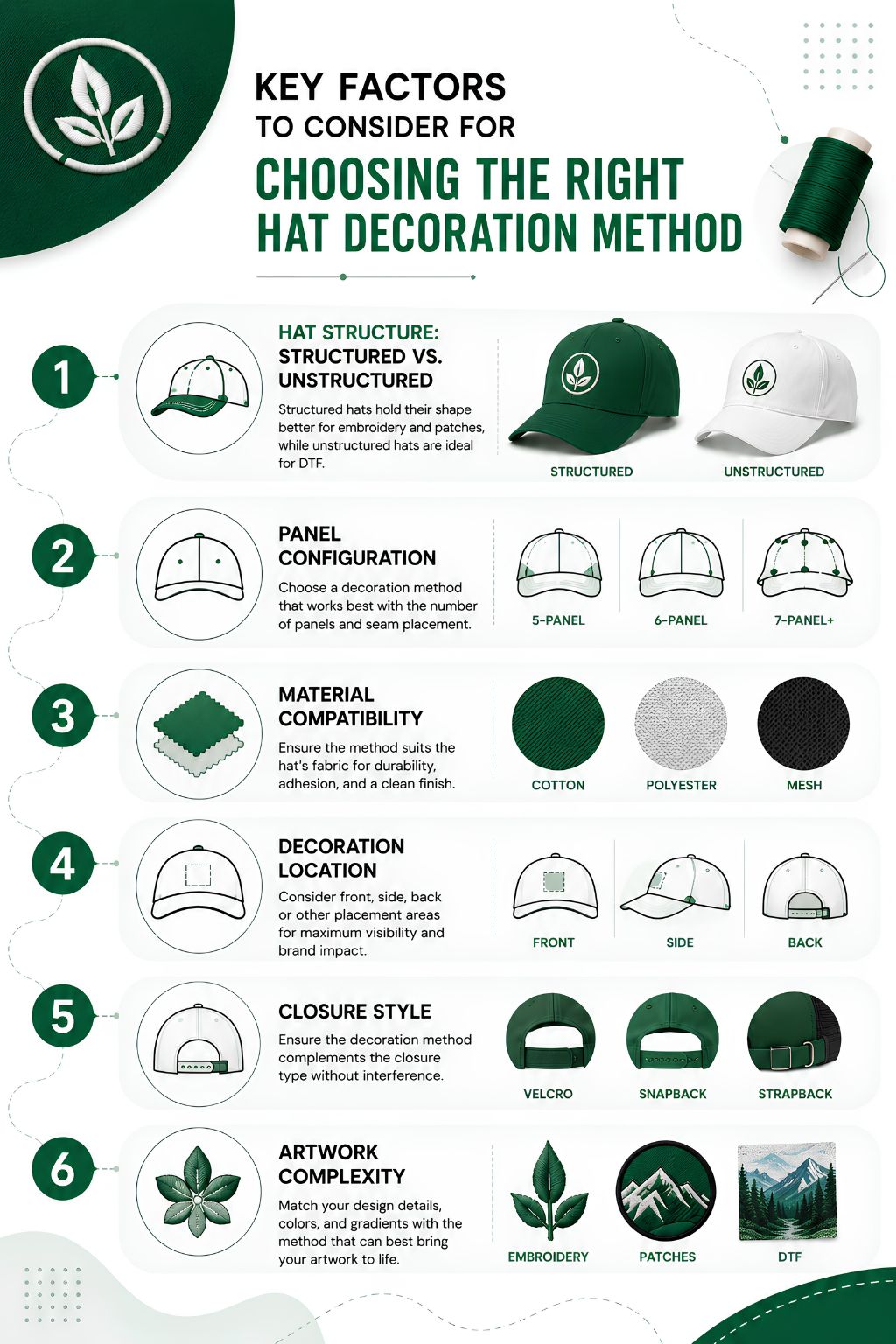
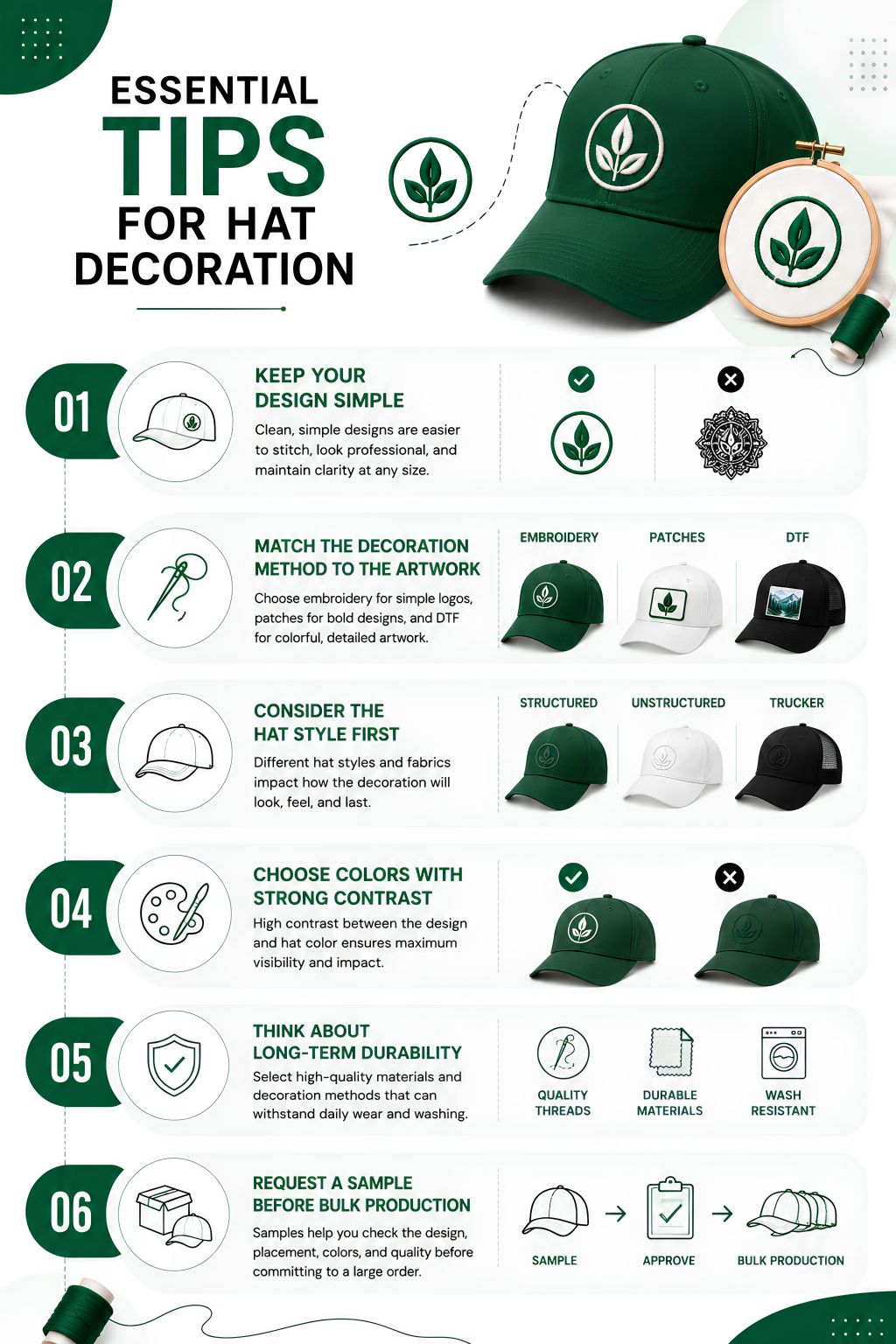
Essential Tips for Hat Decoration
Choosing the right decoration method is only part of creating high-quality custom headwear. Following a few best practices throughout the design and production process ensures your hats look professional, remain durable, and accurately represent your brand.Keep Your Design Simple
Hats offer far less printable space than t-shirts, so simplicity is often more effective. Bold logos, clean typography, and minimal artwork remain highly visible from a distance, while overly detailed designs may lose clarity depending on the decoration method.Match the Decoration Method to the Artwork
Every decoration technique has strengths. Embroidery works best for logos and text, patches add texture and premium appeal, while DTF is ideal for full-color illustrations and intricate graphics. Choosing the appropriate method produces a cleaner final result.Consider the Hat Style First
The construction of the hat should influence your design decisions. Structured trucker hats and snapbacks can accommodate larger logos and 3D embroidery, while low-profile dad hats generally perform better with smaller, cleaner branding that complements the softer crown.Choose Colors with Strong Contrast
Your artwork should stand out against the hat color. High-contrast combinations improve readability and make branding more noticeable. Before production, review digital mockups on every cap color to ensure your design remains clearly visible.Think About Long-Term Durability
Custom hats are designed to be worn repeatedly, so durability matters. Select decoration methods and materials that can withstand regular use without peeling, fading, or losing their appearance. Investing in quality production often delivers better long-term value than simply choosing the lowest-cost option.Request a Sample Before Bulk Production
Even a professionally prepared mockup cannot fully replicate the appearance of a finished hat. Ordering a pre-production sample allows you to evaluate logo placement, color accuracy, decoration quality, and overall appearance before committing to a large order, reducing the risk of expensive production mistakes.