

Key Takeaways:
- Embroidery usually offers the strongest long-term durability for simple logos.
- Printing is better suited to gradients, photographs, and highly detailed artwork.
- The best technique depends on the logo, hat material, and intended use.
- Embroidered logo hats provide a textured, premium appearance.
- Printed hats can offer more creative freedom with color and fine detail.
- Hat construction and production quality can affect durability as much as the decoration method.
Embroidery vs Printing on Hats: Why the Logo Technique Matters
A custom hat is more than a blank accessory with a logo added afterward. The decoration method becomes part of the product’s overall performance. A logo worn on a golf course, construction site, sports field, or outdoor event faces very different conditions from one worn occasionally at a conference. That is why embroidery vs printing on hats should be evaluated based on the full use case. A simple company icon may look excellent as embroidery, while a detailed illustration with gradients may lose important visual information when converted into thread. Embroidery physically integrates thread into the hat. Printing, by comparison, places ink, transfer material, or another printed layer onto the surface. Both can produce professional results, but they respond differently to washing, friction, sunlight, stretching, and design complexity. The best decision is therefore not simply about choosing the method that lasts the longest. It is about choosing the method that lasts while still preserving the design’s intended appearance.How Custom Embroidery on Hats Works
Custom embroidery uses thread stitched directly into the hat’s fabric. Before production, artwork is converted into a digital stitch file through a process called digitizing. The file determines how the machine reproduces the logo, including stitch direction, density, color changes, and sequencing. This process gives custom embroidered hats their distinctive textured appearance. Instead of sitting on top of the material as a flat graphic, the logo becomes a physical part of the hat’s surface. Embroidery is especially effective for:- Simple brand logos
- Text and initials
- Icons and symbols
- Corporate branding
- Sports team logos
- Uniform decoration
How Hat Logo Printing Works
Hat printing includes several different processes, so it is important not to treat all printed decoration as identical. Depending on the hat and supplier, printing may involve direct ink application, heat transfers, silicone printing, reflective materials, or other specialized techniques. The general advantage is flexibility. Printing can reproduce more colors, gradients, fine details, and complex artwork than traditional embroidery. This makes it useful for brands that want a design to look as close as possible to its original digital artwork. Hat logo printing is particularly useful for:- Photographic designs
- Detailed illustrations
- Gradients
- Small visual details
- Large graphic elements
- Designs with many colors
Embroidery vs Printing on Hats: Which Lasts Longer?
For long-term everyday wear, embroidery generally has the durability advantage. Because the design is created with thread stitched into the fabric, it does not peel like a surface transfer. It also avoids the cracking associated with some printed finishes. This makes embroidery a strong choice for:- Work uniforms
- Corporate hats
- Sports teams
- Outdoor organizations
- Repeatedly washed headwear
- Everyday branded apparel
Design Complexity and Detail
Design complexity is one of the clearest differences between embroidery and printing. Embroidery works best when the design has:- Strong shapes
- Clear outlines
- Readable lettering
- Limited colors
- Bold visual elements
- Photographs
- Multiple gradients
- Complex illustrations
- Fine lines
- Subtle shading
- Many colors
Color Options and Brand Accuracy
Color is another important consideration in DTF? No, for this blog, hat decoration. Embroidery typically relies on thread colors. This can produce strong, attractive branding, but the exact appearance may vary slightly from digital colors displayed on a screen. Printing offers broader color flexibility and is generally better for reproducing gradients and complex color transitions. If your brand depends on precise visual effects, photographic color, or multiple shades, printing may offer more freedom. However, color accuracy still depends on production quality. A printed logo can be technically capable of reproducing many colors but still look poor if color management is inconsistent. For most businesses, the question is not simply “Which technique has more colors?” It is: Does the decoration method reproduce the brand accurately at the size and scale required? For simple logos, embroidery often provides excellent visual consistency. For complex artwork, printing generally offers more flexibility.Look, Feel, and Perceived Quality
The physical feel of a logo strongly influences how people perceive a hat. Embroidery creates a raised, textured finish. This often gives embroidered logo hats a premium, traditional appearance. That is why embroidery is so common on corporate headwear, golf apparel, uniforms, premium merchandise, and established brand collections. Printing creates a smoother, flatter finish. Depending on the technique, it may feel almost integrated into the fabric or create a slight surface layer. Neither appearance is automatically better. The right choice depends on the personality of the brand. A luxury golf brand may prefer the texture of embroidery. A creative streetwear label may prefer a bold printed graphic. A sports organization may use embroidered logos for official team hats while offering printed designs for fan merchandise. The decoration should match the product’s intended role.Material Compatibility and Hat Construction
The hat itself can determine which decoration method works best. Embroidery requires enough structure and stability for the material to support stitching. Structured front panels are often well suited to embroidered logos, while very lightweight or delicate fabrics may require special handling. Printing also depends on the surface. A smooth, stable panel can provide a better base for printed artwork than a highly textured or flexible surface. Hat construction matters because:- Seams can interfere with decoration.
- Curved panels can affect logo placement.
- Stretch fabrics may require specialized techniques.
- Mesh panels may not support all decoration methods.
- Foam-front hats may be particularly suitable for certain printed designs.
Print Size and Logo Placement
Size is an important factor in the embroidery vs printing on hats decision. Embroidery is often ideal for smaller front logos, center-front branding, side logos, and compact lettering. Large embroidered designs can become heavy, dense, or visually overwhelming. Printing may offer more flexibility for larger graphic areas, especially on suitable flat or foam-front panels. However, oversized printed designs may also affect the hat’s feel and appearance. The most important consideration is proportion. A logo should fit the available panel without overwhelming the hat. Before production, consider:- Front-panel dimensions
- Seams
- Curvature
- Logo width
- Height-to-width ratio
- Visibility from a distance
Durability in Real-World Conditions
The real durability test begins after the hat leaves the production facility. Everyday wear can expose logos to:- Sweat
- Rain
- Sunlight
- Friction
- Repeated washing
- Folding and storage
- Outdoor conditions
Production Time, Cost, and Order Quantity
Cost depends on more than the decoration method. It may include artwork preparation, digitizing, setup, materials, labor, hat selection, and order quantity. Embroidery costs are often influenced by stitch count and design complexity. A simple logo may be relatively efficient, while a dense design can require more production time. Printing costs vary based on the technique, artwork, size, colors, and production setup. For bulk orders, both methods can become more cost-effective as quantities increase. However, the cheapest per-unit price should not be the only consideration. A low-quality logo that needs to be replaced can create higher costs than a slightly more expensive decoration method that lasts longer.Choosing the Right Hat Style for Each Logo Technique
The hat style should support both the design and the decoration method.Baseball Caps
Baseball caps are versatile and work well for corporate branding, schools, sports teams, and everyday promotional use. Their structured front panels often provide a dependable surface for embroidery.Trucker Hats
Trucker hats are popular for outdoor brands, events, casual teams, and lifestyle businesses. Their front panel can create opportunities for different decoration approaches depending on the material.Snapbacks
Snapback hats suit streetwear brands, youth groups, fan merchandise, and modern organizations. Their structured design can support bold branding and strong logo placement.Flexfit Hats
Flexfit hats are a strong choice for corporate apparel, golf groups, premium team wear, and fitted preferences. Embroidery often complements their polished appearance.Dad Caps
Dad caps offer a relaxed, casual look for creators, clubs, lifestyle brands, and informal organizations. Smaller embroidered logos often work particularly well with this style.Embroidery vs Printing on Hats: Which Method Should You Choose?
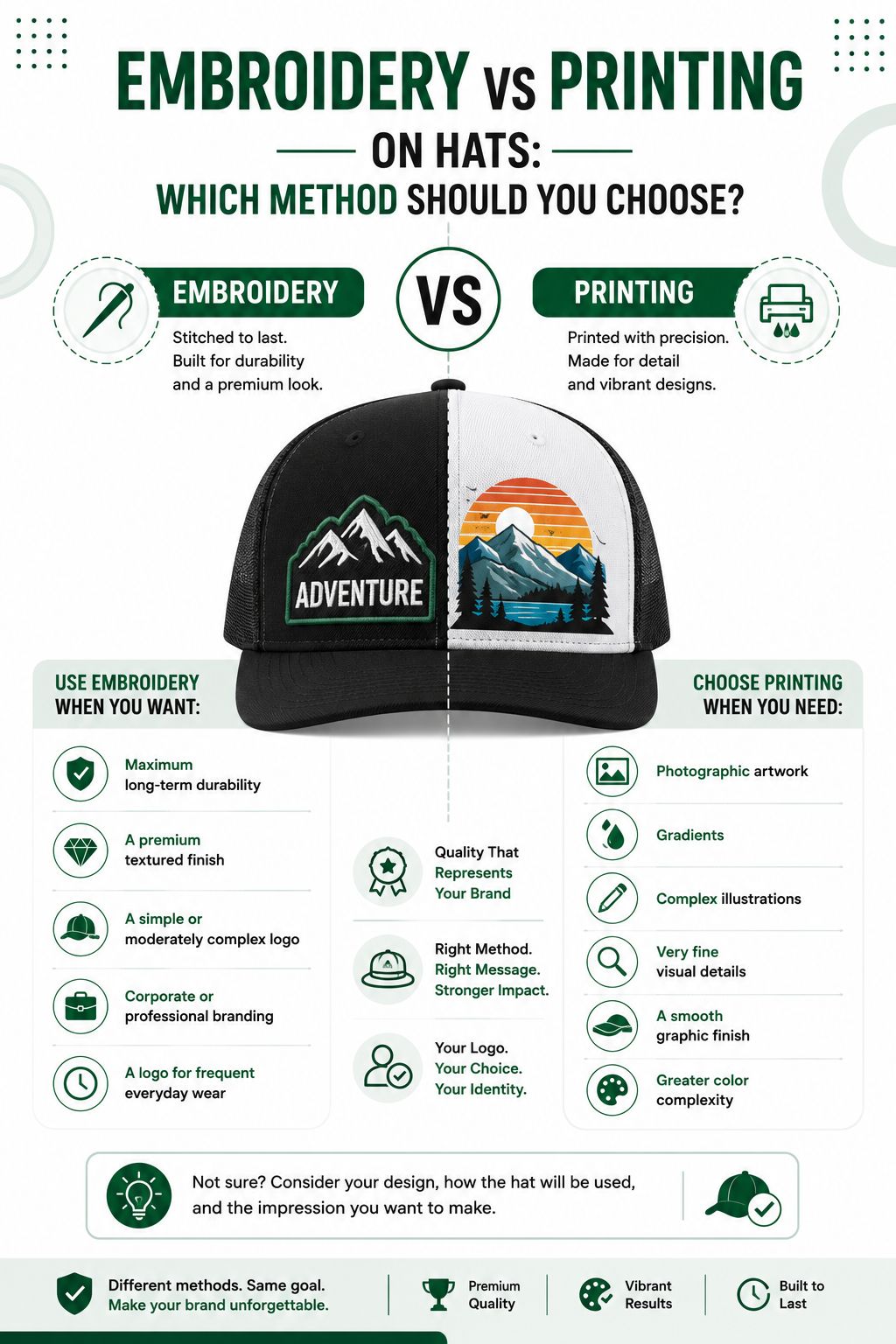
Use embroidery when you want:- Maximum long-term durability
- A premium textured finish
- A simple or moderately complex logo
- Corporate or professional branding
- A logo for frequent everyday wear
- Photographic artwork
- Gradients
- Complex illustrations
- Very fine visual details
- A smooth graphic finish
- Greater color complexity