

Scroll through any brand’s merch drop and you’ll spot the difference right away. Some logos sit flat against the cap. Others rise off the front panel like they’re about to jump. That raised look is the signature of 3d embroidery hats, and it’s one of the most requested upgrades in custom headwear right now.
But raised isn’t automatically better. Flat stitching has been the backbone of hat embroidery for decades, and plenty of designs look sharper, cleaner, and more professional when they stay flat. The real question is which technique fits your logo, your hat style, and your goals.
This guide breaks down how each method works, where 3d embroidery hats shine, where flat stitching wins, and what to expect on cost, durability, and care. By the end, you’ll know exactly what to ask for when you order custom hat embroidery for your business, team, or event.
What Is Flat Embroidery, and Why Is It Still the Standard for Hat Embroidery?
Flat embroidery is the classic approach. A machine stitches thread directly into the cap fabric, usually with satin stitches for borders and lettering and fill stitches for larger shapes. The finished design lies smooth against the hat with a subtle woven texture. At Hat.co, a single flat design can use up to 15 thread colors, which gives you a lot of room to match brand palettes.
The biggest strength of flat embroidery is detail. Thin outlines, small text, delicate script lettering, and layered color work all come through clearly because the thread sits right on the surface instead of wrapping around a raised foam core. It also works on nearly every headwear style, from structured caps to soft, unstructured ones.
That versatility is why flat stitching remains the default for most corporate logos, uniforms, and team caps. When someone says they want embroidery on hats and doesn’t specify the style, flat is almost always what they get. It’s dependable, durable, and easy to reproduce across a large order, and it’s the baseline you’ll want to measure 3d embroidery hats against.
What Are 3D Embroidery Hats and How Is the Puff Effect Made?
The 3D effect comes from a layer of foam. Before the design is stitched, a thin sheet of foam is placed over the cap. The machine then sews dense satin stitches across the foam, and those tight stitches both cover the foam and perforate it. Once the stitching is done, the excess foam gets torn away from around the design, leaving a padded shape trapped under the thread. The result is a logo that stands roughly a few millimeters off the cap, which is why 3d embroidery hats catch the light and cast tiny shadows that flat designs can’t.
You’ll hear several names for this technique. 3d puff embroidery hats, puff embroidery hats, and simply “puff” all describe the same process. The foam can be color-matched to the thread, which matters because any sliver of contrasting foam peeking out along an edge can look sloppy. That’s one reason this technique rewards experience.
Puff also has limits. Foam needs a solid, bold shape to hold onto. It works beautifully on thick lettering and simple icons and struggles with anything tiny or intricate, which we’ll get into below.
How Do 3D Embroidery Hats Compare to Flat Embroidery on Looks, Feel, and Durability?
On looks, the two styles send different messages. Flat embroidery feels refined and understated. It says established brand, clean uniform, professional polish. Puff embroidery feels bold and dimensional, and it’s a staple of streetwear, athletic apparel, and any brand that wants its logo to be noticed from across the room. If visibility is your priority, 3d embroidery hats have a clear edge, since the raised surface reads from a distance in a way flat thread doesn’t.
On feel, puff has a firm, cushioned texture you can actually feel with your fingertip. Flat is smooth and low-profile. Some people love the tactile quality of puff, while others prefer a cap that feels lighter and more traditional.
Durability is closer than most people expect. Both techniques use the same polyester or rayon thread, and both are stitched into the cap for the long haul. The difference is how they handle abuse. Flat embroidery is more forgiving when a hat gets stuffed into a backpack or crushed under a gym bag. The foam in puff embroidery hats can compress over time if the cap is repeatedly flattened, so puff does best when the hat is treated with a little care. For most wearers, both styles last for years.
Which Designs Work Best for 3D Embroidery Hats?
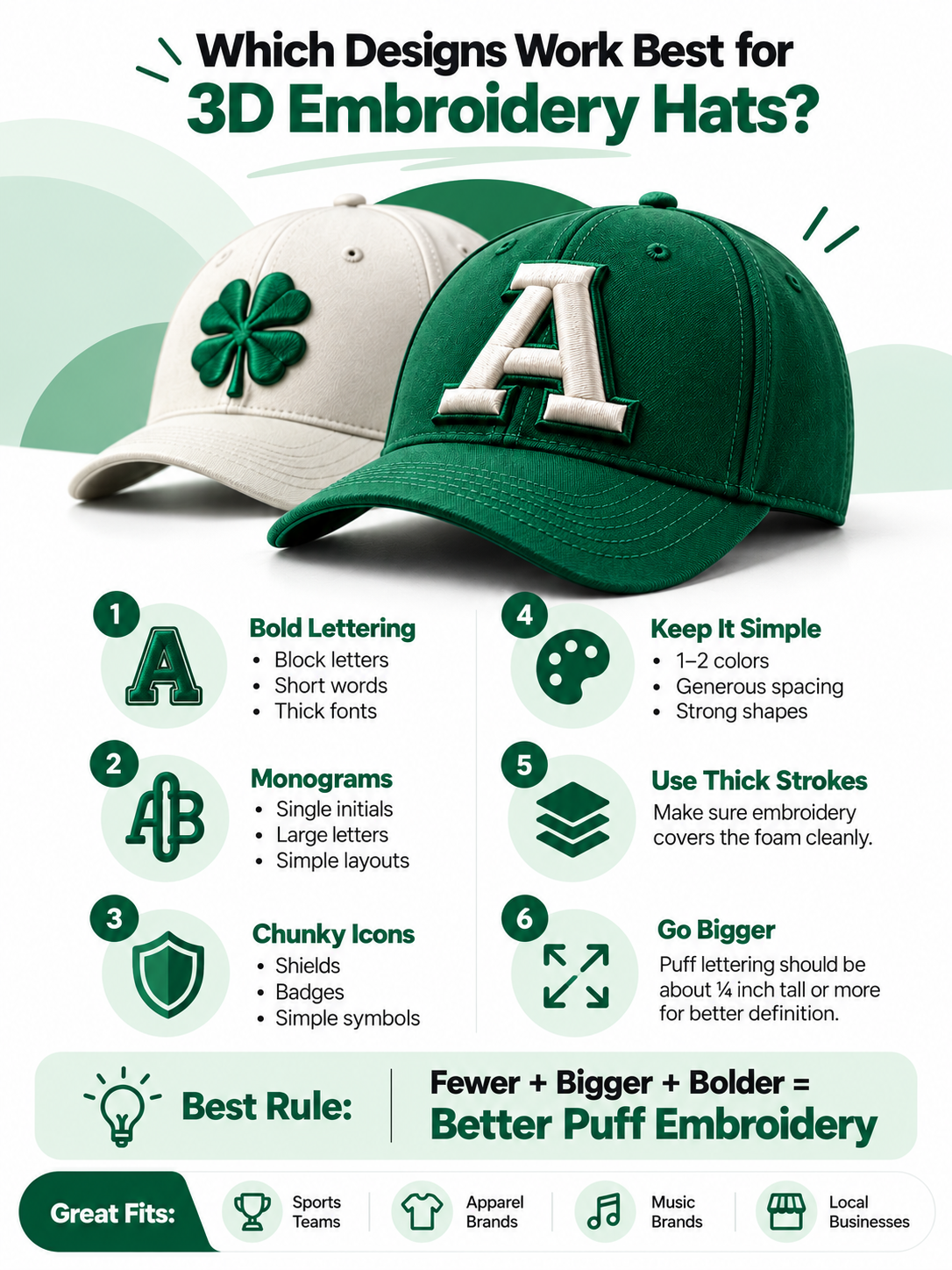
Bold and simple wins. Block letters, monograms, short brand names, and chunky icons are ideal because they give the foam a wide, stable shape to sit under. A single large initial, a thick wordmark, or a simple shield can look fantastic as a raised element.
As a general rule, puff lettering should be at least about a quarter inch tall, and taller is often better for the cleanest edges. Strokes need to be thick enough to cover the foam completely. If you’re designing a logo for 3d embroidery hats, think “fewer, bigger, bolder.”
Designs that suit this approach tend to share a few traits: a limited number of colors, generous spacing between letters, and strong shapes that read well even at a glance. Sports teams, music brands, apparel labels, and local businesses with a short, punchy name are common fits. If your artwork already looks good as a one- or two-color stamp, it will likely translate well into puff.
Which Designs Are Better Left to Flat Embroidery?
Anything that depends on fine detail belongs in flat stitching. Thin script fonts, small taglines, tight serifs, intricate illustrations, and logos with lots of tiny elements can turn into a muddy blob when foam gets involved, because the stitches need room to wrap and cover it.
If your artwork has gradients, shading, or photographic detail, flat embroidery may still fall short, and that’s where other decoration methods can help. Hat.co also offers custom patch hats for detailed or textured artwork, along with DTF transfers for full-color, photo-quality designs. A quick conversation with the production team can save you from paying for a technique that doesn’t flatter your logo.
When in doubt, remember that flat is never a downgrade. A crisp, well-digitized flat logo often looks more expensive than a poorly planned puff design.
Which Hat Styles Hold Up Best for 3D Embroidery Hats?
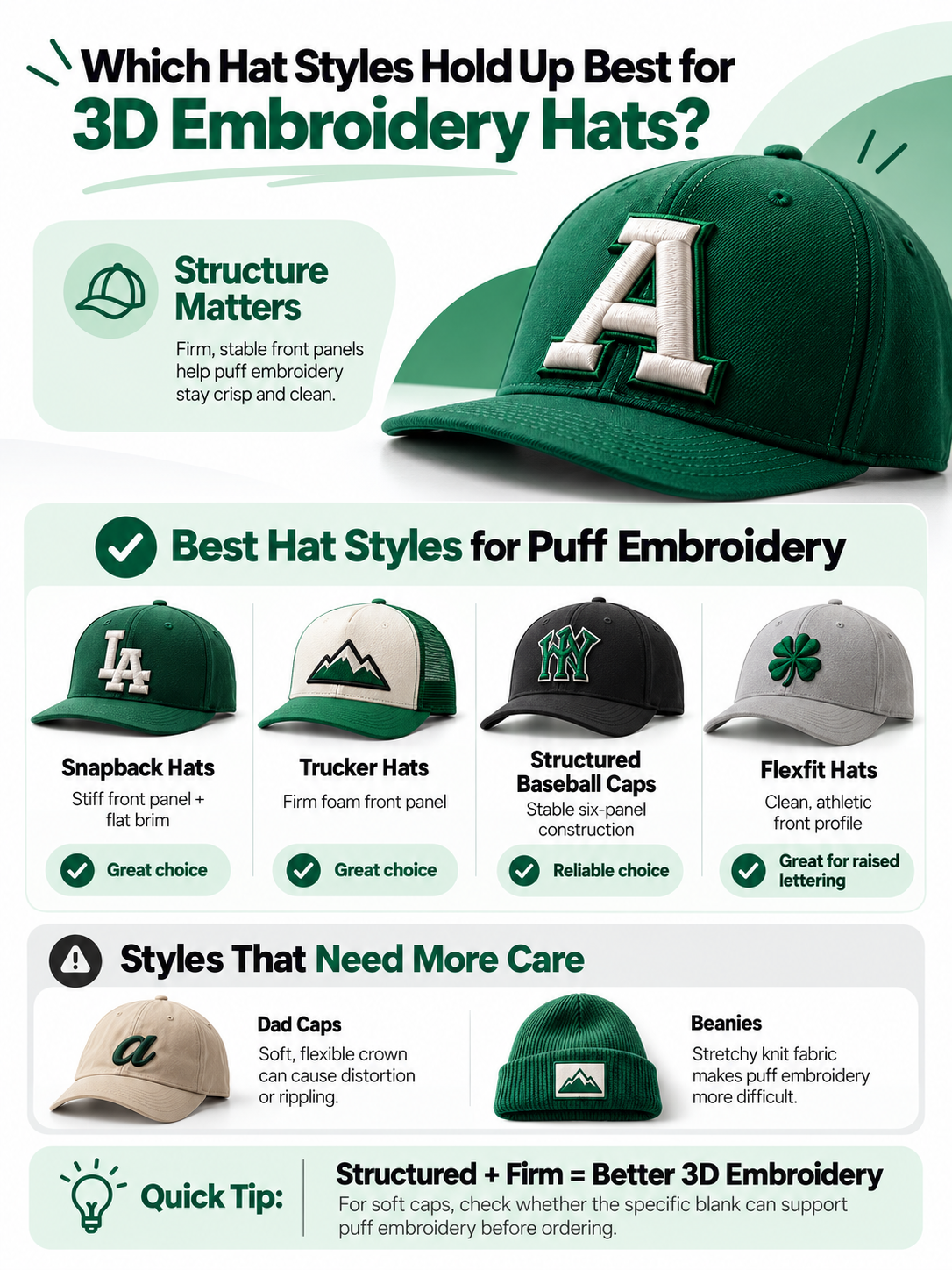
Structure matters more than almost anything else. Puff needs a firm, stable surface so the foam stays crisp and the stitches don’t pucker. That makes structured caps the best canvas for 3d embroidery hats.
Custom snapback hats are a natural fit, with their stiff, flat-brimmed front panels. Custom trucker hats work well too, since the foam front panel gives the stitches solid backing. Custom baseball caps in structured six-panel builds are another reliable choice, and custom Flexfit hats offer a clean, athletic profile that shows off raised lettering nicely.
Soft, unstructured styles are trickier. Custom dad caps have a relaxed crown that flexes, and that movement can distort foam-based designs or make the stitching ripple. Puff is still possible with the right stabilizing, but flat is usually the safer call there. Beanies are even less suited to puff because their knit fabric stretches. If you’re set on a raised look for a soft cap, ask the team whether your specific blank can handle it before you commit.
Why Does Digitizing Matter So Much for Professional Hat Embroidery?
Before any thread touches a cap, your artwork has to be digitized. That means converting your logo into a stitch file that tells the machine where to sew, in what direction, how dense, and in what order. For flat embroidery, good digitizing keeps lettering sharp and prevents puckering. For puff, it’s even more critical.
A digitizer building a puff file has to set stitch density high enough to cover the foam, add underlay to hold everything in place, and plan perforation so the foam tears away cleanly. Get any of that wrong and you’ll see foam poking through, ragged edges, or lettering that looks bloated. This is the main difference between a casual embroidery job and professional hat embroidery, and it’s why experienced shops test and adjust files before running a full order.
At Hat.co, every quote comes with a free digital mockup, so you can see how your design will be placed before production begins. That proof step is your chance to catch scale, spacing, or placement issues early. If you’re sending custom hat embroidery artwork that includes small text, speak up, since the team can suggest simple tweaks that make the final stitching cleaner.
How Much Do 3D Embroidery Hats Cost Compared to Flat Embroidery?
Puff generally costs more than flat. The foam is an added material, the digitizing is more involved, and the stitching is slower and denser. Pricing for both techniques depends on the same core factors: design size, stitch count, number of thread colors, hat style, and total quantity. Larger orders spread setup costs across more hats, which brings the per-hat price down.
If you want the look of 3d embroidery hats without stretching your budget, there are a few smart moves. Use puff on just one key element, like a monogram or a single word, and keep the rest of the design flat. Simplify the artwork so it needs fewer color changes. And order in volume when you can, since setup effort is a fixed cost no matter how many caps you run.
The easiest way to get a real number is to request a free custom hat embroidery quote with your artwork and quantity. Orders start at 12 hats, and most quotes come back in under two hours, so you can compare flat and puff pricing side by side before deciding.
Can You Combine Flat and 3D Embroidery on the Same Hat?
Yes, and it’s one of the best ways to get the most out of custom hat embroidery. Many of the best-looking caps use a raised main element paired with flat supporting details. Picture a bold, puffed monogram on the front with a thin flat outline around it, or a chunky puffed brand name sitting above a small flat tagline.
This hybrid approach plays to the strengths of each technique. The puff draws the eye to the most important part of the design, while flat stitching handles the fine lines that foam can’t. It also helps control costs, since only part of the design requires foam. Many brands that start with 3d embroidery hats for a single hero logo end up using hybrid builds across an entire product line, because it gives them depth and detail in the same piece.
For any embroidery on hats that mixes techniques, the digitizing has to be planned carefully so the two styles don’t collide. A professional team will map out which parts get foam and which stay flat before stitching begins.
How Do You Care for 3D Embroidery Hats?
Caring for 3d embroidery hats is simple, but a few habits make a big difference. The goal is to protect the foam and keep the raised shape intact.
Skip the washing machine and dryer. Instead, spot clean with a damp cloth and a little mild soap, dab gently rather than scrubbing, and let the cap air dry. Store your hat on a shelf or hook rather than stacking heavy items on top of it, and avoid cramming it into bags where the front panel gets flattened. If the crown loses its shape, stuffing it lightly with a towel while it dries can help it hold its form. Never iron directly over the raised area, since heat can squash the foam.
These steps are worth the effort for puff embroidery hats in particular, but they’re good practice for any embroidered cap. A little care keeps your logo looking sharp for years.
How Do You Order Custom Hat Embroidery and Get the Best 3D Embroidery Hats?
Ordering is more straightforward than most people expect. Start by choosing your hat style. Then send in your logo, or ask for help building one, and approve the digital proof Hat.co sends back. After that, production and shipping move quickly. Standard turnaround is 4 business days, and rush orders can ship in as fast as 24 hours.
Hat.co is the custom headwear division of STL Shirt Co, a union-certified print shop serving customers nationwide since 1975. That kind of experience matters when you’re asking for professional hat embroidery with a technique as detail-sensitive as puff. You can browse every custom hat embroidery service to see styles, brands, and decoration options in one place.
Before you submit your order, it helps to have your artwork ready as a clean, high-resolution file, a rough idea of your quantity, and a sense of whether you want flat, puff, or a mix. If you’re not sure, say so. Helping customers pick the right method is part of the job.
Frequently Asked Questions About 3D Embroidery Hats
What are 3D embroidery hats?
3D embroidery hats feature designs stitched over a layer of foam, which creates a raised, padded effect on the cap. The technique is also called puff embroidery and works best with bold lettering and simple shapes.
Are 3D puff embroidery hats more expensive than flat embroidery?
Usually, yes. Puff requires foam, more complex digitizing, and slower stitching, so it costs more than flat. Using puff on just one part of the design and keeping the rest flat is a budget-friendly way to get the look for less.
Which hats work best for puff embroidery hats?
Structured caps work best, including snapbacks, trucker hats, baseball caps, and Flexfit styles. Soft, unstructured caps like dad hats can flex under the foam, so flat embroidery is typically the safer choice for them.
How long do 3D embroidery hats last?
With basic care, 3D embroidery hats can last for years, since the thread is just as durable as in flat embroidery. Avoid crushing the front panel and skip the washing machine to keep the raised effect looking its best.
What is the minimum order for custom hat embroidery at Hat.co?
Hat.co’s minimum order is 12 hats. Standard turnaround is 4 business days, and rush service is available as fast as 24 hours.
Ready to Order 3D Embroidery Hats for Your Brand?
Both techniques have a place. Flat embroidery delivers clean detail and a polished, understated finish, while 3d embroidery hats bring bold dimension that gets noticed. The right pick comes down to your artwork, your hat style, and the impression you want to make. And if you can’t decide, a hybrid of the two often gives you the best of both.
If you’re ready to see how your logo would look in puff, flat, or a combination, get your free quote from Hat.co and we’ll send a free digital mockup so you can approve it before anything is stitched.