

Embroidery vs DTF for Hats: What’s the Difference?
Before comparing the two methods, it helps to understand how each one works.What Is Hat Embroidery?
Hat embroidery uses thread that is stitched directly into the fabric of a cap. Instead of sitting as a flat graphic on the surface, the design becomes part of the hat through rows of stitches. This creates the raised texture that makes embroidered logos instantly recognizable. It is particularly effective for simple logos, bold lettering, symbols, and designs that use a limited number of solid colors. Embroidery is also closely associated with professional and premium branding. Company logos, sports team designs, workwear, uniforms, and promotional headwear frequently use embroidered decoration because of its traditional appearance. For structured hats such as snapbacks and trucker caps, embroidery can create a particularly strong visual presence. However, embroidery does have limitations. Extremely small text, very fine lines, smooth gradients, and photographic artwork can be difficult to reproduce accurately with thread.What Is DTF Printing for Hats?
DTF stands for Direct-to-Film printing. Instead of stitching a design into the hat, the artwork is printed onto a special film and then transferred onto the hat using heat. One of the biggest advantages of DTF is its ability to reproduce complex artwork. Multiple colors, gradients, intricate illustrations, and photo-style graphics can be represented much more easily than with traditional embroidery. DTF also produces a relatively flat finish rather than the raised texture associated with thread. This can be useful when you want your design to retain a lightweight feel while still featuring a high level of visual detail.Embroidery vs. DTF Printing at a Glance
Embroidery vs. DTF Printing
Compare finish, design capabilities, detail, color options, and overall appearance to choose the right decoration method.
| ✨ Factor | 🧵 Embroidery | 🎨 DTF Printing |
|---|---|---|
| Finish | Raised and textured | Smooth and printed |
| Best For | Simple, bold logos | Detailed artwork |
| Color Capability | Best with solid colors | Excellent for multicolor designs |
| Gradients | Limited | Well suited |
| Photographic Designs | Not ideal | Well suited |
| Overall Aesthetic | Classic and premium | Vibrant and modern |
| Weight | Can add structure | Generally lightweight |
| Fine Details | More challenging | Better suited |
Quick Tip:
Choose embroidery for simple logos and a classic, textured, premium appearance. Choose DTF printing for detailed artwork, gradients, photographs, and vibrant multicolor designs.
Embroidery vs DTF for Hats: Which Looks Better?
There is no universal winner when it comes to appearance. The better-looking method depends on the artwork and the style you’re trying to achieve.The Premium, Textured Look of Embroidery
Embroidery is often chosen when the goal is a traditional, polished, or premium appearance. The thread creates a physical dimension that you can see and feel. A simple brand logo can look especially striking when stitched onto a cap because the texture adds depth without requiring complicated artwork.Embroidery is a strong option for:
- Corporate logos
- Sports teams
- Workwear
- Brand merchandise
- Event hats
- Simple typography
- Bold symbols
The Vibrant, Detailed Look of DTF
DTF takes a different visual approach. Rather than emphasizing texture, DTF focuses on reproducing the artwork itself. This makes it useful when your design includes multiple colors, fine visual elements, gradients, or photographic details. Consider an illustration containing several shades of the same color. Recreating those subtle transitions with embroidery thread can be difficult. DTF, however, can reproduce those visual changes as part of the printed artwork.DTF can therefore be particularly useful for:
- Complex illustrations
- Full-color artwork
- Gradient-heavy designs
- Detailed graphics
- Photo-style artwork
- Designs requiring precise color reproduction
How Design Complexity Changes the Decision
Your artwork should be one of the first things you consider when deciding between the two methods. A simple logo with bold shapes and a few solid colors generally lends itself well to embroidery. A detailed illustration containing numerous colors, gradients, or photographic elements may be better suited to DTF.Think about it this way:
Simple + bold + textured = embroidery Detailed + colorful + smooth = DTF That basic distinction can eliminate much of the confusion surrounding embroidery or DTF for hats.Embroidery vs DTF Printing: Durability, Comfort, and Everyday Wear
Appearance is important, but it isn’t the only factor. If you’re ordering custom hats for employees, customers, teams, events, or everyday use, you should also consider how the decoration will perform during regular wear.How Durable Is Embroidery on Hats?
Because embroidery uses thread that is stitched directly into the fabric, it provides a highly integrated form of decoration. Well-executed embroidery can maintain its appearance through regular use and does not have the same type of surface-film concerns associated with printed decoration. This is one reason embroidered hats are frequently used for workwear, uniforms, sports teams, and other applications where hats may be worn repeatedly. However, embroidery isn’t automatically perfect for every design. A very dense embroidered design can add weight and stiffness to the front of the hat. Design size, stitch density, thread selection, hat construction, and application quality can all affect the final result.How Does DTF Hold Up on Hats?
DTF uses a printed transfer rather than stitched thread. Its performance can depend on factors such as the quality of the transfer, application process, hat material, care, and frequency of use. Its main advantage isn’t necessarily that it is universally more or less durable than embroidery. Instead, DTF’s strength is its ability to reproduce artwork that would be difficult to create with thread. This makes it particularly valuable when design detail is more important than a raised texture.Which Is More Comfortable?
Comfort can also influence the decision. Embroidery can create additional structure and weight on the decorated area, especially when a design contains substantial stitching. Some wearers may appreciate the structured feel, while others may prefer a flatter decoration. DTF provides a printed surface without the buildup of multiple rows of thread. For lightweight everyday hats, that can be an attractive characteristic. Your choice should therefore consider how the hat will actually be worn rather than focusing only on the appearance of the logo.Does the Hat Style Affect the Decision?
Yes. The hat itself matters. A structured snapback, for example, provides a different decoration surface than a soft dad hat. A Flexfit hat has different construction and fit characteristics, while a beanie presents another type of surface altogether. If you’re comparing custom flexfit hats, custom dad hats, custom beanies, custom baseball caps, or custom trucker hats, consider both the decoration method and the construction of the headwear. The goal is for the decoration and hat style to work together.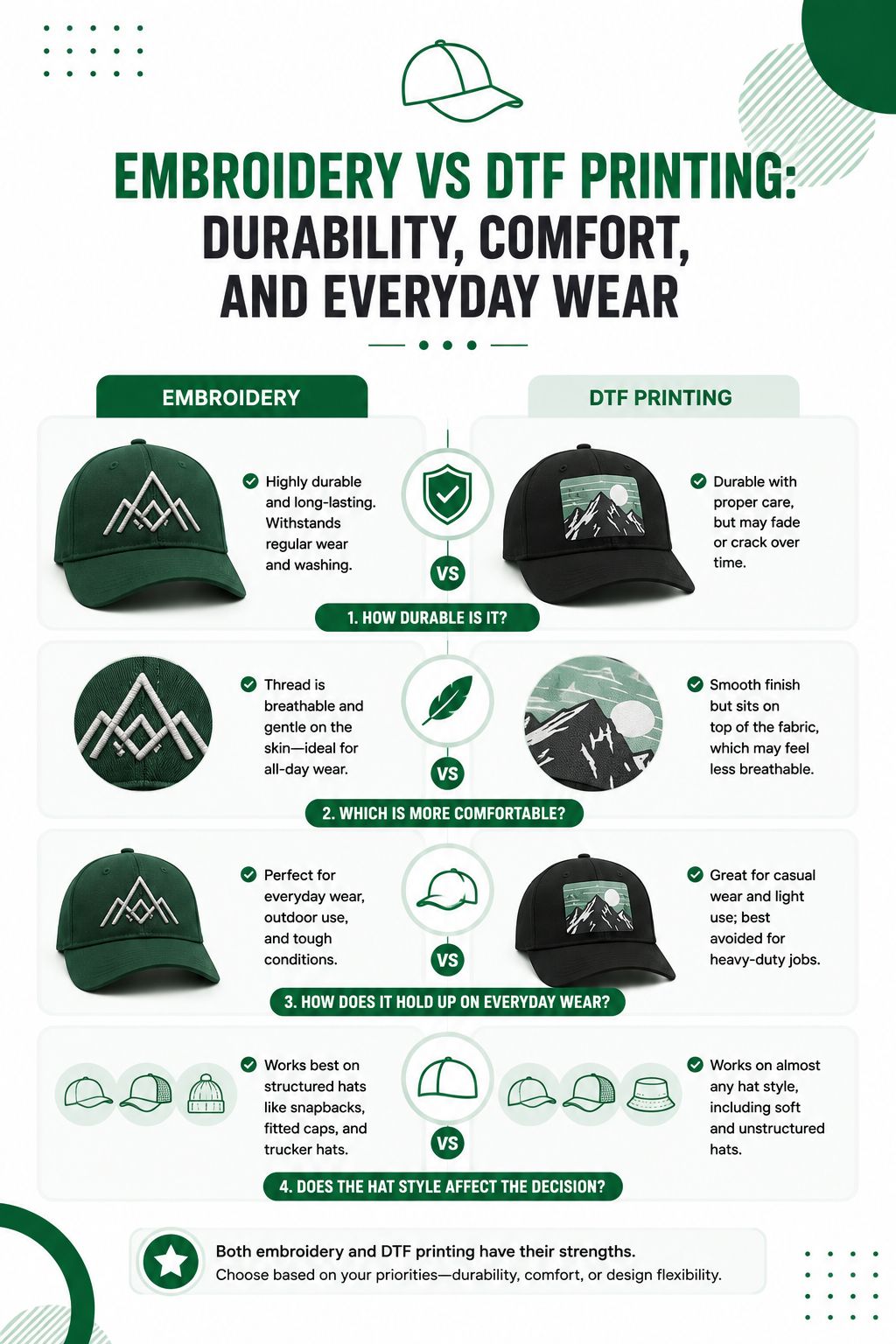
Embroidery or DTF for Hats? Match the Method to Your Design
Once you understand the differences, the decision becomes much easier.Choose Embroidery When You Have a Simple, Bold Logo
Embroidery is generally a strong choice when your artwork:
- Uses a limited number of colors
- Contains bold shapes
- Includes readable lettering
- Has a relatively uncomplicated logo
- Needs a raised or textured appearance
- Is intended for professional or traditional branding
Choose DTF When Your Artwork Is Detailed or Color-Heavy
DTF is worth considering when your artwork contains:
- Many colors
- Gradients
- Fine details
- Intricate illustrations
- Photographic elements
- Complex color transitions
Consider the Type of Hat You’re Customizing
Your hat style should also influence the decision. For structured styles, embroidered logos can create a traditional branded appearance. For more relaxed or fashion-focused headwear, the choice may depend more heavily on the artwork and desired visual effect.When exploring options, you can consider:
- custom snapback hats for structured, adjustable headwear
- custom flexfit hats for stretch-fit designs
- custom dad hats for a relaxed, casual look
- custom beanies for cold-weather branding
- custom baseball caps for versatile everyday headwear
- custom trucker hats for structured caps with a recognizable mesh-back style
Think About Your Budget and Order Size
Cost is another consideration, particularly for businesses ordering hats in larger quantities. The final price of custom hat decoration can vary based on the hat style, decoration size, design complexity, quantity, production requirements, and other factors. If embroidery is your preferred method, understanding the different factors involved can help you plan your budget. For additional information, see this guide to custom hat embroidery cost. Rather than choosing a decoration method solely because it appears cheaper, consider the overall value of the finished product.Embroidery vs DTF for Hats: Pros and Cons at a Glance
Pros and Cons of Embroidery
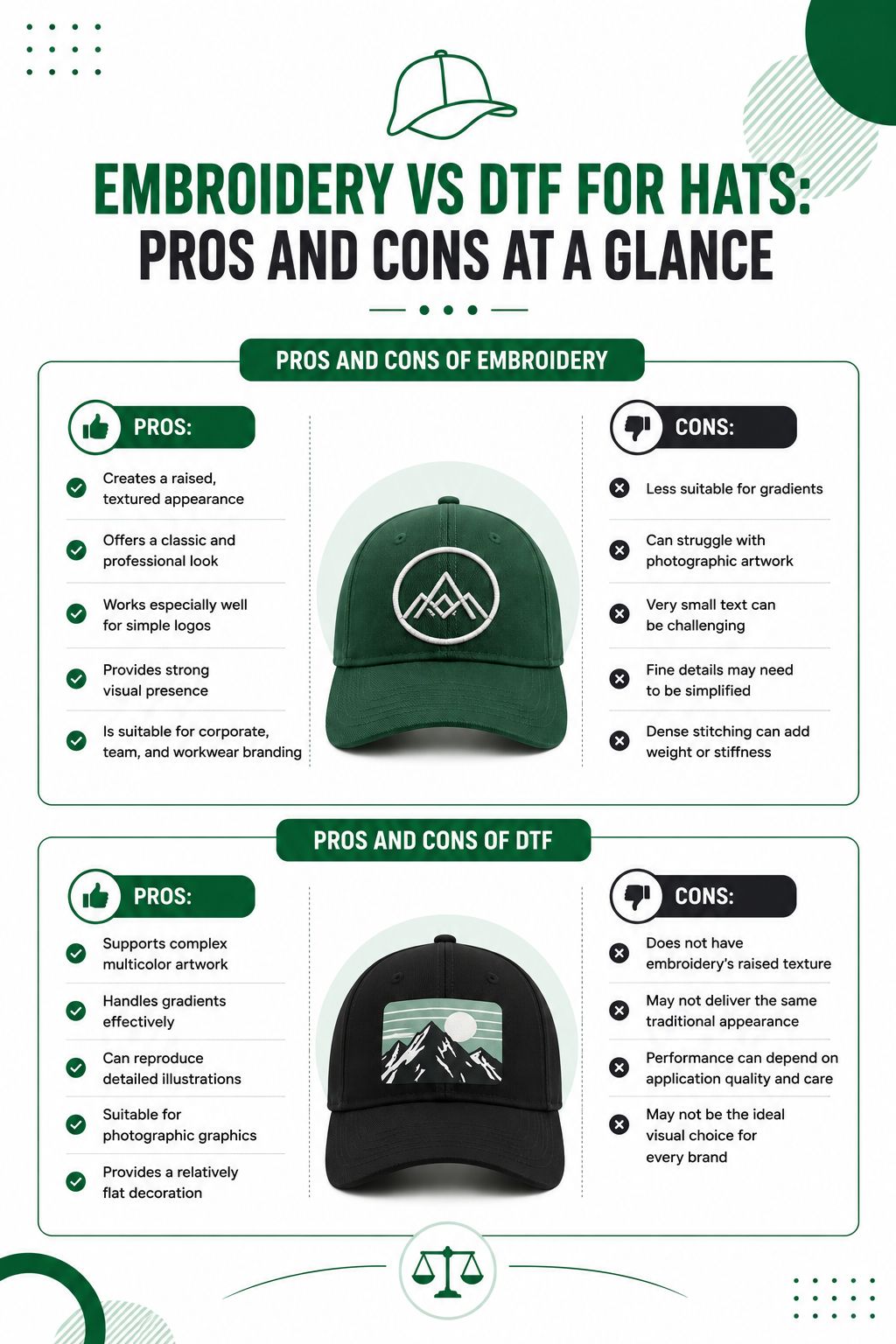
Pros:
- Creates a raised, textured appearance
- Offers a classic and professional look
- Works especially well for simple logos
- Provides strong visual presence
- Is suitable for corporate, team, and workwear branding
Cons:
- Less suitable for gradients
- Can struggle with photographic artwork
- Very small text can be challenging
- Fine details may need to be simplified
- Dense stitching can add weight or stiffness
Pros and Cons of DTF
Pros:
- Supports complex multicolor artwork
- Handles gradients effectively
- Can reproduce detailed illustrations
- Suitable for photographic graphics
- Provides a relatively flat decoration
Cons:
- Does not have embroidery’s raised texture
- May not deliver the same traditional appearance
- Performance can depend on application quality and care
- May not be the ideal visual choice for every brand
Is There a Middle Ground?
You don’t necessarily have to think of the decision as a strict two-way competition. Embroidered patches can provide another option for certain hat designs. A patch can introduce additional detail while retaining a more dimensional, tactile appearance than a conventional print. This can be worth considering if your design is too detailed for traditional direct embroidery but you still want a textured branded look. The right choice ultimately depends on the artwork, hat, intended use, and appearance you’re trying to achieve.Best Hat Printing Method: How to Make the Final Choice
If you’re still unsure, use a simple decision process.Choose Embroidery If:
- Your logo is simple and bold.
- You use only a few solid colors.
- You want a raised or textured finish.
- Your brand has a professional or traditional aesthetic.
- You’re decorating structured hats.
- Long-term everyday use is a priority.
Choose DTF If:
- Your design contains gradients.
- Your artwork includes photographic elements.
- You need many colors.
- Fine visual details are important.
- You’re working with an intricate illustration.
- You want a smooth printed appearance.
Ask These Questions Before Ordering
Before selecting a method, ask yourself:- How detailed is my artwork?
- How many colors does it contain?
- Do I want texture or a smooth finish?
- How frequently will the hats be worn?
- Which hat style am I using?
- How many hats do I need?
- What details must remain visible in the final design?